
}})
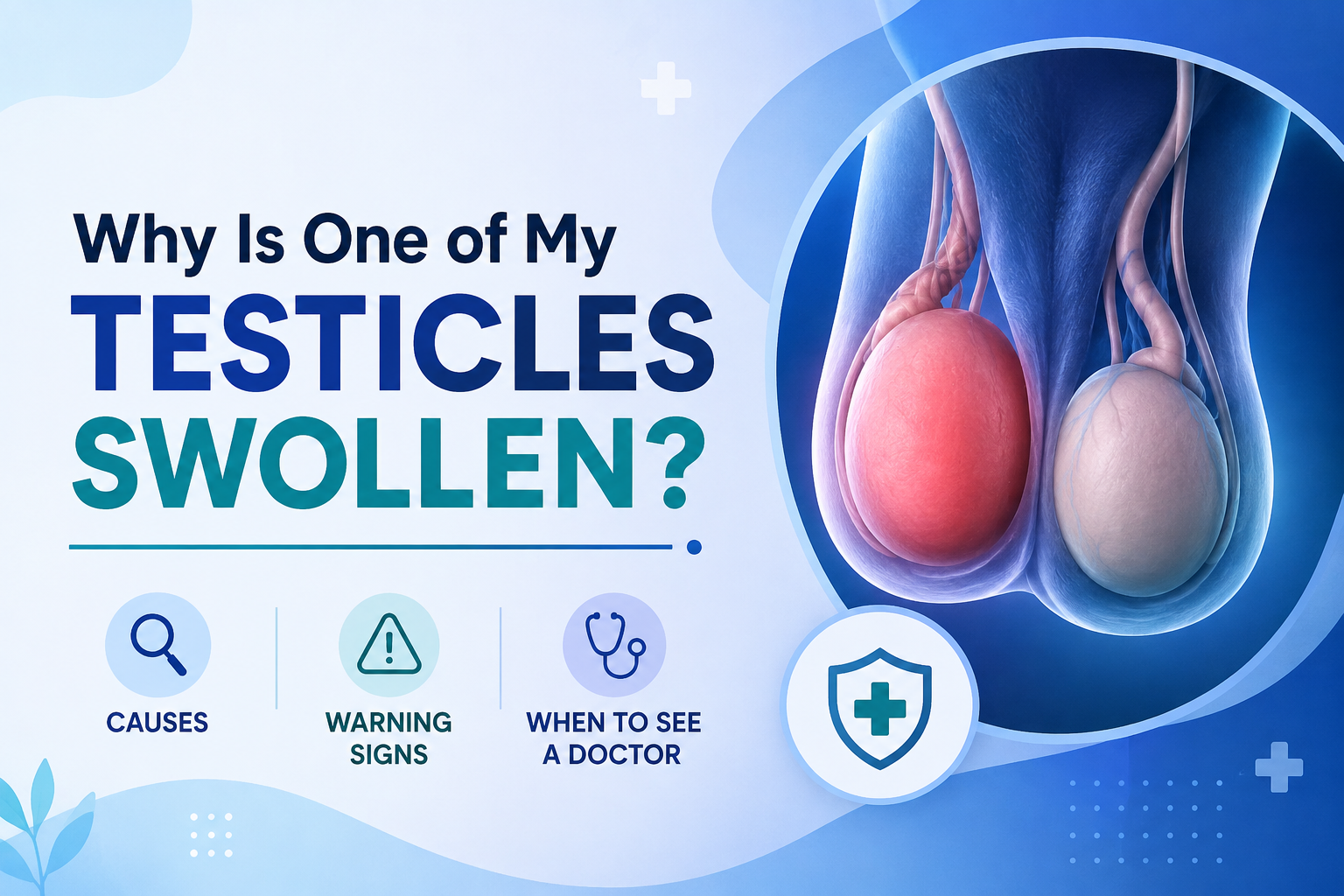
A swollen testicle can come from many causes, most of them treatable. Common reasons include hydrocele (fluid around the testicle), varicocele (enlarged veins), infection of the epididymis or testicle, an inguinal hernia, or injury. However, sudden severe swelling with intense pain can be testicular torsion, a surgical emergency where the testicle must be saved within about six hours. If swelling appears suddenly with severe pain, nausea, or fever, seek emergency care immediately. Painless, gradual swelling still needs prompt evaluation to rule out cancer.
Noticing that one of your testicles looks or feels bigger than the other can be alarming. Sometimes it is nothing, and sometimes it matters. This guide walks through every common cause of testicular swelling, explains the key clinical split between sudden and gradual swelling, and tells you exactly when it is an emergency and when it is not.
When a Swollen Testicle Is a Medical Emergency
Before anything else, one condition must be ruled out: testicular torsion. This is when the spermatic cord twists and cuts off blood supply to the testicle. Without treatment within about six hours, the testicle can die.
Go to the emergency room immediately if a swollen testicle is accompanied by:
- Sudden, severe pain in one testicle, often starting without warning
- Rapid swelling of the scrotum on one side
- Nausea or vomiting with the pain
- A testicle that sits higher than usual or looks abnormally positioned
- Severe pain after a minor knock, or with no clear trigger
Two other emergencies to know about: Fournier's gangrene is a rare but life-threatening infection of the scrotum that causes rapid swelling, dark discoloration, and severe pain, often with fever, and needs immediate hospital care. Incarcerated inguinal hernia is a hernia that has become trapped, causing painful groin and scrotal swelling that does not reduce, and also needs urgent attention. When in doubt, treat it as an emergency.

Is It Normal for One Testicle to Be Bigger Than the Other?
Yes. A small size difference between the two testicles is completely normal, and most men have one testicle that hangs slightly lower than the other, usually the left. The two testicles are not identical, and small differences are simply anatomy.
What is not normal is a new change, a noticeable difference that was not there before, or a difference in shape, firmness, or texture rather than just size. If one testicle has recently become bigger, feels different, or looks different from before, it is not normal and deserves an evaluation.
Sudden vs Gradual Swelling: The Key Clinical Distinction
The most useful question when working out why a testicle is swollen is: how quickly did it happen? The answer narrows the diagnosis dramatically.
- Sudden swelling (over minutes to hours): usually testicular torsion, trauma, or a severe infection. Almost always painful. Treat as an emergency until proven otherwise.
- Rapid swelling (over hours to a day or two): typically epididymitis, orchitis, or an incarcerated hernia. Usually painful, often with fever or urinary symptoms.
- Gradual swelling (over days to weeks): commonly hydrocele, spermatocele, or a slowly reducible hernia. Usually painless or only mildly uncomfortable.
- Slowly progressive over weeks to months: varicocele, chronic hydrocele, or (rarely) testicular cancer. Often painless. Any painless progressive swelling deserves urgent evaluation.
Painless does not mean harmless. Some of the most important causes, including cancer, present as painless swelling.
What Causes One Testicle to Swell?
Once torsion has been ruled out, the causes of testicular swelling fall into a handful of common categories.

Hydrocele (Fluid Around the Testicle)
A hydrocele is a collection of clear fluid inside the scrotum, around the testicle. It feels like a soft, painless swelling that surrounds the testicle rather than a distinct lump, and it usually enlarges gradually over weeks to months. Hydroceles are one of the most common causes of a swollen testicle in adult men and are usually harmless. Small hydroceles are often observed, while larger ones can be drained or repaired surgically when they cause discomfort.
Varicocele (Enlarged Veins)
A varicocele is like a varicose vein in the scrotum, caused by faulty valves in the veins that drain the testicle. It feels like "a bag of worms" above and around the testicle, and it swells more noticeably when standing or straining. Varicoceles are far more common on the left side due to differences in vein anatomy. Most are painless, though some cause a dragging ache and can affect fertility, which is when treatment is considered.
Epididymitis (Infection of the Epididymis)
Epididymitis is inflammation of the coiled tube behind the testicle, usually caused by a bacterial infection or a sexually transmitted infection. It typically causes a gradually worsening one-sided swelling with pain, warmth, redness of the scrotum, and sometimes burning during urination. It responds well to the right antibiotics, rest, and scrotal support. If burning urination is one of your symptoms, our guide on burning urination causes beyond a UTI covers the overlap.
Orchitis (Infection of the Testicle)
Orchitis is inflammation of the testicle itself, sometimes from the same bacterial infection as epididymitis, and sometimes from viral illnesses such as mumps. It causes swelling, pain, and often fever. Bacterial orchitis is treated with antibiotics; viral orchitis is treated with rest, pain relief, and time.
Testicular Trauma
A direct blow to the testicles can cause significant swelling and bruising within minutes to hours. Mild cases settle over days. Severe trauma can lead to a haematoma or, rarely, testicular rupture, which needs urgent ultrasound and sometimes surgery. Any severe or persistent swelling after injury should be evaluated the same day.
Inguinal Hernia
A hernia in the groin can push tissue down into the scrotum, causing a lump or swelling that often becomes more noticeable when standing, coughing, or lifting. Hernias do not resolve on their own and typically need surgical repair. An incarcerated hernia (one that has become trapped) is a surgical emergency.
Spermatocele (Sperm-Filled Cyst)
A spermatocele is a fluid-filled cyst on the epididymis behind the testicle. It feels like a smooth, movable, painless lump separate from the testicle itself. Small spermatoceles are left alone; larger or symptomatic ones can be removed surgically.
Testicular Torsion (Emergency)
Torsion causes sudden, severe swelling with intense pain and nausea, often in adolescents and young men. Because torsion is a surgical emergency, it is worth revisiting: sudden severe testicular swelling and pain are always torsion until proven otherwise. Our detailed guide on why do my testicles hurt explains torsion in full.
Testicular Cancer
Testicular cancer usually appears as a painless, firm lump or enlargement of the testicle itself. It can present as swelling of the whole testicle or as a specific hard area on it, sometimes with a heavy feeling in the scrotum or lower abdomen. The important reassurance: testicular cancer is uncommon and one of the most treatable cancers when caught early. Any painless enlargement of the testicle deserves urgent evaluation. Our guide on what to do if you find a lump in your testicle explores this in full.
Swelling by Pattern: What Different Swellings Usually Mean
The way the swelling looks and feels often points to the likely cause. The table below matches common patterns with their most likely explanations.
| Swelling pattern | Likely cause |
|---|---|
| Sudden, severe, one-sided, very painful | Testicular torsion (emergency) |
| Painful swelling with fever and burning urination | Epididymitis, orchitis |
| Painless soft swelling around the testicle | Hydrocele |
| "Bag of worms" above the testicle, worse standing | Varicocele |
| Painless, smooth, movable lump behind the testicle | Spermatocele |
| Bulge that appears on standing or coughing | Inguinal hernia |
| Swelling after a knock or fall | Trauma, occasionally testicular rupture |
| Painless enlargement or firm change of the testicle itself | Testicular cancer (rule out) |
| Rapid swelling with dark skin and fever | Fournier's gangrene (emergency) |
This is a starting point, not a diagnosis. A scrotal ultrasound is the single most useful test for sorting these out.
Related Symptoms to Watch For
A swollen testicle becomes more meaningful when it comes with other symptoms. Tell your doctor if you also have:
- A visible lump, firmness, or change in shape of the testicle
- Burning or pain during urination
- Discharge from the penis or under the foreskin
- Fever, chills, or feeling generally unwell
- Nausea or vomiting
- Pain radiating to the lower abdomen, groin, or thigh
- Blood in the urine or semen
- Skin changes over the scrotum such as redness, warmth, or dark discoloration
These clues often point straight to the underlying cause and shape which tests are needed urgently.
When to See a Doctor
Book a consultation with a urologist if:
- Any new or unexplained swelling of a testicle appears
- One testicle has become noticeably bigger than the other
- You feel a lump, firmness, or change in the shape of a testicle
- Swelling is accompanied by mild pain, discomfort, or heaviness
- Swelling develops gradually over days to weeks
Seek urgent or emergency care if:
- Swelling is sudden and accompanied by severe pain
- You have nausea, vomiting, or fever with the swelling
- The scrotal skin is red, dark, or warm to the touch
- A groin bulge cannot be reduced back into the abdomen
- Swelling appears after a significant injury
Testicular swelling is not something to wait out. Even benign conditions become more difficult to manage the longer they are ignored.
How a Swollen Testicle Is Diagnosed
Diagnosis is usually quick and painless. A urologist will typically:
- Take a full history, including how quickly the swelling appeared, any pain or other symptoms, sexual history, and recent injury
- Examine the scrotum, testicles, groin, and abdomen to feel the swelling and its relationship to the testicle
- Order a scrotal ultrasound, the single most useful test. It uses no radiation, is painless, and can distinguish fluid-filled swelling from a solid mass in minutes.
- Check a urine test and, if relevant, screen for sexually transmitted infections
- Add blood tests when infection, inflammation, or a mass is suspected, including tumour markers if cancer is possible
Most causes become clear within one visit and the ultrasound.
How a Swollen Testicle Is Treated
Treatment always follows the cause:
- Hydrocele: observed if small and painless; drained or surgically repaired if large or uncomfortable
- Varicocele: managed conservatively or surgically repaired if it causes pain or affects fertility
- Epididymitis and bacterial orchitis: targeted antibiotics, rest, scrotal support, and anti-inflammatories
- Viral orchitis (e.g., mumps): rest, pain relief, and time
- Inguinal hernia: surgical repair, urgent if incarcerated
- Spermatocele: removed only when large or symptomatic
- Testicular trauma: ice, support, and pain relief for minor injuries; ultrasound and possible surgery for severe cases
- Testicular torsion: immediate surgery to untwist and save the testicle
- Testicular cancer: surgical removal of the affected testicle (orchidectomy), followed by close monitoring or further treatment as needed
Whatever the cause, early evaluation almost always makes treatment simpler and more successful.
Expert Care for Men's Health in Delhi NCR
A swollen testicle is a private, worrying symptom, and it deserves an unhurried, expert consultation. Dr. Ashish Saini is a urologist and andrologist at Excel Advanced Urology Center in Greater Kailash 1, New Delhi, whose practice covers the full spectrum of male urological and reproductive health.
- MCh Urology from AIIMS, New Delhi
- MBBS and MS from KGMU, Lucknow
- 15+ years of clinical experience in urology and andrology
- 21,000+ surgeries performed across urological procedures
This combined urology and andrology expertise means testicular swelling is evaluated properly and discreetly, with a physical exam and ultrasound on the same visit wherever possible, and a clear diagnosis in hours rather than weeks of worry.
If you have noticed swelling or a change in one of your testicles, do not wait. Book an online consultation for a confidential assessment and clear next steps.