
}})
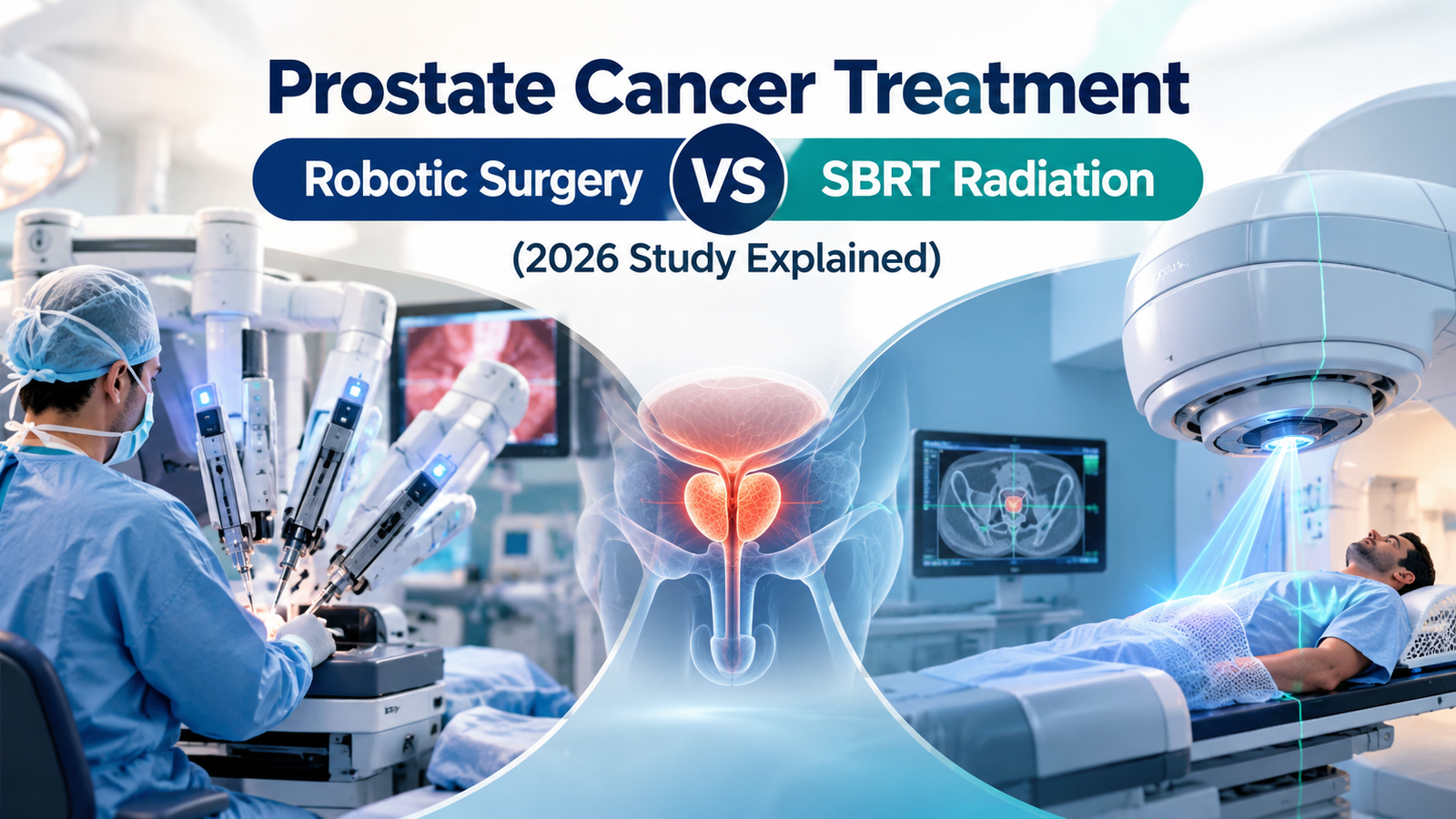
For low and intermediate-risk prostate cancer, both radical prostatectomy (surgery) and SBRT (5-session radiation) give excellent long-term cancer control. The 2026 PACE-A trial found that about 94% to 95% of men stayed free of cancer recurrence at 5 years with either option. SBRT caused less urine leakage, while surgery gives exact staging and keeps radiation available as a backup. The best choice depends on your PSA, Gleason score, age, overall health, and personal priorities.
Hearing the words "prostate cancer" is frightening. Then comes a second shock: you are asked to choose a treatment. Should you have the prostate removed, or should you have radiation? Many men in Delhi NCR come to us after getting different advice from different doctors, and they feel stuck.
In September 2026, a major international study called PACE-A gave patients and doctors something they had never had before: long-term, randomised data comparing modern prostate surgery with 5-session SBRT radiation. This blog explains what the study found, what it does not prove, and how to decide which path suits you.
Why This Decision Matters More in 2026
Prostate cancer is now among the most commonly diagnosed cancers in Indian men, especially in cities, where PSA testing and MRI are more widely available. More men are being diagnosed early, when the cancer is still inside the prostate. That is good news, because early prostate cancer is highly curable.
But early diagnosis also means more men face a real choice. When two treatments cure the cancer equally well, the deciding factors become:
- Urinary control after treatment
- Sexual function
- Bowel health
- Recovery time and time away from work
- What happens if the cancer comes back
This is exactly the gap the PACE-A trial set out to fill.
First, Understand Your Prostate Cancer Risk Group

Before comparing treatments, your urologist places your cancer into a risk group. This is the single most important factor in choosing treatment.
| Risk Group | PSA Level | Gleason Score | Usual Options |
|---|---|---|---|
| Low risk | Below 10 ng/mL | 6 (3+3) | Active surveillance, surgery or radiation |
| Intermediate risk | 10 to 20 ng/mL | 7 (3+4 or 4+3) | Surgery or radiation, sometimes with hormone therapy |
| High risk | Above 20 ng/mL | 8 to 10 | Surgery or radiation combined with other treatments |
Your clinical stage (how far the tumour has spread on examination and MRI) also matters. A PSMA PET scan may be advised in some cases to check whether the cancer has spread outside the prostate.
Important: The PACE-A results apply only to low and intermediate-risk prostate cancer. They do not apply to high-risk or spread disease.
What Is Radical Prostatectomy?
Radical prostatectomy is surgery to remove the entire prostate gland along with the seminal vesicles. Today it is most often done using robotic or laparoscopic techniques through small keyhole cuts.
How Robotic and Nerve-Sparing Surgery Works
In robotic surgery, the surgeon controls fine instruments with magnified 3D vision. This allows careful dissection around the delicate nerves that control erections and the muscle that controls urine. When the cancer allows it, these nerves can be preserved, which is called nerve-sparing surgery.
Benefits of Surgery
- The whole prostate is removed and examined under a microscope, giving exact staging and grading
- PSA should drop to almost zero, making follow-up simple
- If the cancer returns, radiation is still available as a second treatment
- No risk of radiation-related bowel or bladder irritation
- Treatment is completed in a single operation
Possible Side Effects of Surgery
- Urine leakage, especially in the first few months. Most men improve steadily with pelvic floor exercises, but some have long-term leakage
- Erectile dysfunction, which depends on age, prior function and whether nerves were spared
- Hospital stay and recovery of a few weeks before returning to full activity
Leakage after surgery happens because the prostate sits right next to the urinary sphincter and the urethra. Surgical skill and experience play a large role in how well continence recovers.
What Is SBRT for Prostate Cancer?
SBRT stands for stereotactic body radiotherapy. It delivers very precise, high-dose radiation to the prostate in just 5 sessions, usually over one to two weeks. Older radiation schedules needed 20 to 40 daily visits.
How SBRT Works
Advanced imaging and tracking guide each radiation beam so that the tumour gets a high dose while nearby organs such as the bladder and rectum are spared as much as possible. No cut, no anaesthesia and no hospital stay are needed.
Benefits of SBRT
- No surgery, no hospital admission
- Only 5 sessions, with most men continuing normal daily life
- Lower risk of urine leakage than surgery
- Better preservation of sexual function in many men
Possible Side Effects of SBRT
- Temporary burning, frequent urination or urgency
- Bowel irritation, such as loose motions or rectal discomfort
- Gradual decline in erectile function over the years
- If cancer returns, salvage surgery is possible but technically harder after radiation
The PACE-A Trial: What the 2026 Study Found

The PACE-A results were presented at the American Society for Radiation Oncology (ASTRO) Annual Meeting in Boston in September 2026. It is the first phase 3 randomised trial to directly compare prostatectomy with SBRT.
Who Was Studied
- 123 men with low or intermediate-risk prostate cancer at 8 centres in the United Kingdom
- All were fit for surgery
- 60 were randomly assigned to prostatectomy and 63 to SBRT (36.25 Gy in 5 sessions)
- No hormone therapy was given
- Men were followed for a median of about 8 years
Cancer Control Results
Both treatments controlled cancer extremely well. At 5 years, about 94.8% of men after SBRT and 94.1% after surgery were free of PSA recurrence. At 8 years, cancer control remained excellent in both groups.
Quality of Life Results
This is where the two treatments differed clearly:
- Urine leakage: At 5 years, 8.3% of SBRT patients used at least one pad daily, compared with 48% of surgery patients
- Sexual function: Scores declined in both groups but stayed higher after SBRT
- Bowel problems: Moderate or major bowel issues were uncommon in both groups
What the Study Does Not Prove
Good medicine means reading the fine print:
- The trial was small, with only 123 patients
- It was not designed to prove that SBRT and surgery are equal for cancer control
- All patients were treated in UK centres, and results may vary with local surgical and radiation expertise
- It does not apply to high-risk cancer
The researchers concluded that all men considering surgery for early prostate cancer should be told about SBRT before deciding. We agree. An informed patient makes better decisions.
Robotic Surgery vs SBRT: Side-by-Side Comparison
| Factor | Radical Prostatectomy | SBRT (5-Session Radiation) |
|---|---|---|
| Cancer control (5 years, PACE-A) | About 94% | About 95% |
| Number of treatments | One operation | 5 sessions |
| Hospital stay | Yes, a few days | No |
| Long-term urine leakage | More common | Less common |
| Erectile function | Often affected early | Declines more gradually |
| Bowel side effects | Rare | Possible, usually mild |
| Exact pathology report | Yes | No |
| Backup if cancer returns | Radiation | Salvage surgery (more complex) |
Who May Be Better Suited for Surgery?
Surgery may be the better fit if you:
- Are younger and healthy, with a long life expectancy
- Want the cancer physically removed and fully staged
- Have significant urinary symptoms from an enlarged prostate along with cancer
- Have bowel conditions such as inflammatory bowel disease
- Want to keep radiation in reserve as a second line of treatment
Who May Be Better Suited for SBRT?
SBRT may be the better fit if you:
- Have medical conditions that increase surgical risk
- Strongly want to avoid urine leakage
- Prefer no hospital stay and a shorter recovery
- Have low or intermediate-risk cancer that meets SBRT criteria
A good urologist does not push one treatment for everyone. The right answer comes from your reports, your health and what matters most to you.
What About Active Surveillance?
For many men with low-risk prostate cancer, immediate treatment is not needed at all. Active surveillance means regular PSA tests, MRI and repeat biopsy when needed, with treatment started only if the cancer shows signs of growing. This avoids side effects for men whose cancer may never cause harm. Ask your urologist whether you qualify before choosing surgery or radiation.
Prostate Cancer or Enlarged Prostate? Do Not Confuse the Two
Many men assume that frequent urination or a weak stream means cancer. In most cases, these symptoms come from benign prostatic hyperplasia (BPH), a non-cancerous enlargement. BPH has completely different treatments, such as TURP and other minimally invasive options. A raised PSA alone does not confirm cancer either. Proper evaluation with MRI and, if needed, a targeted biopsy is essential. You can learn more on our prostate disease treatment page.
Prostate Cancer Care in Delhi with Dr. Ashish Saini
Choosing between surgery and radiation should never be rushed. At Excel Advanced Urology Centre, Greater Kailash 1, New Delhi, Dr. Ashish Saini helps each patient understand their risk group, review their MRI and biopsy reports, and compare every suitable option honestly.
Why patients trust Dr. Ashish Saini:
- MCh Urology from AIIMS New Delhi, one of India's most respected urology training programmes
- MBBS and MS from KGMU Lucknow
- 15+ years of experience and more than 21,000 urological surgeries
- Expertise across prostate, bladder and urethral conditions
- A patient-first approach that explains surgery, radiation and surveillance without bias
- Coordination with radiation oncologists when SBRT is the better fit
If you or a family member has a raised PSA or a new prostate cancer diagnosis, a second opinion can bring clarity. Book an online consultation to discuss your reports with Dr. Saini.
Key Takeaways
- Both surgery and SBRT offer excellent long-term control for low and intermediate-risk prostate cancer
- SBRT caused far less urine leakage in the PACE-A trial
- Surgery provides exact staging and keeps radiation available as a backup
- The study was small and does not prove the treatments are equal
- Active surveillance may suit many low-risk cases
- The best choice is personal and should be made with an experienced urologist
Medically reviewed by Dr. Ashish Saini, MCh Urology (AIIMS New Delhi), MBBS, MS (KGMU Lucknow) Senior Urologist, Excel Advanced Urology Centre, Greater Kailash 1, New Delhi | 15+ years of experience | 21,000+ surgeries Last updated: October 2026
Reference
- American Society for Radiation Oncology (ASTRO). Five-treatment radiation therapy offers effective nonsurgical alternative for localized prostate cancer. News release, September 28, 2026. astro.org