
}})
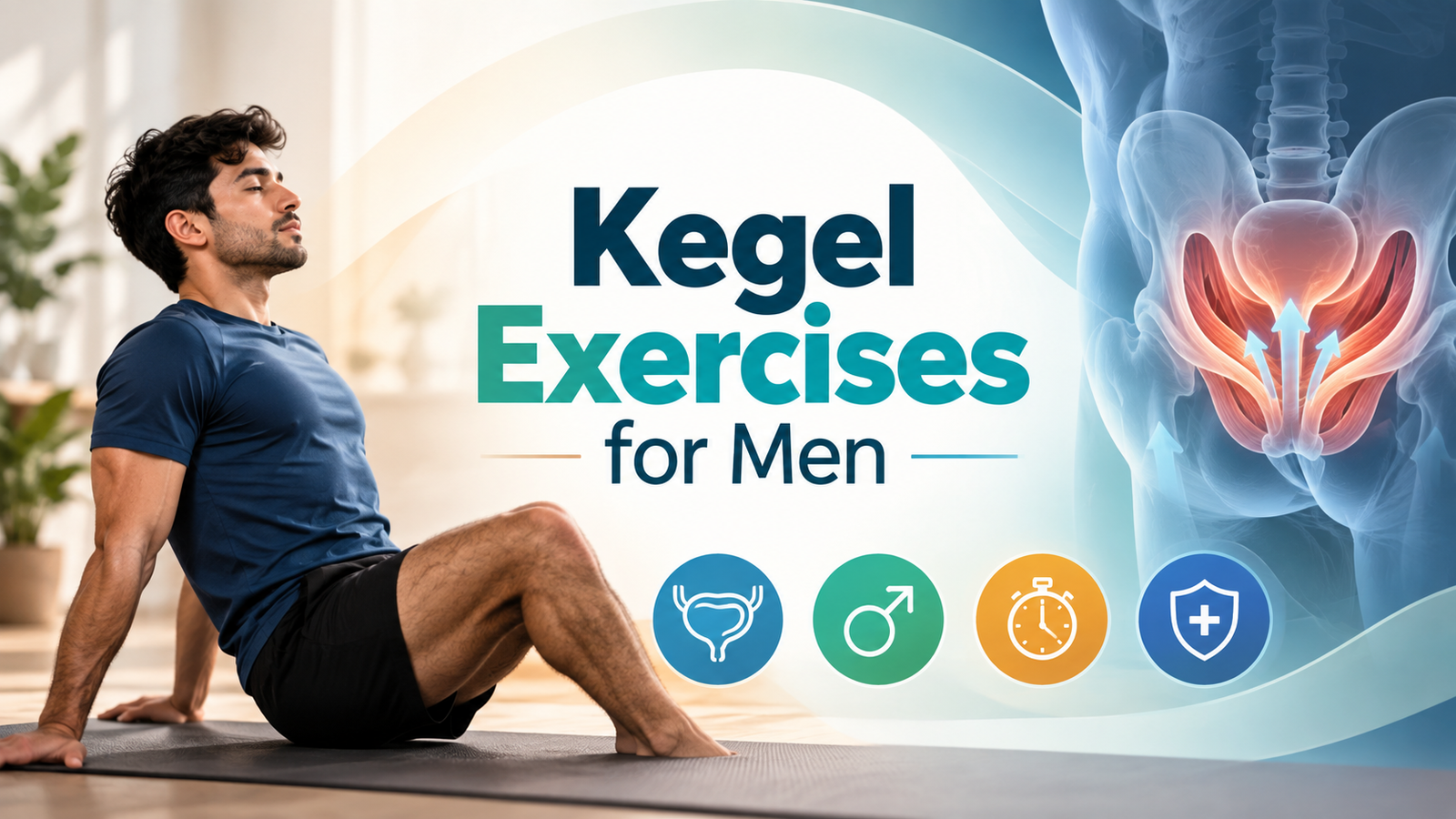
Kegel exercises for men strengthen the pelvic floor muscles that support the bladder, control urine flow, and help maintain erections. To do them, tighten the muscles you use to stop urinating or hold back gas, hold for 3 to 5 seconds, then fully relax for the same amount of time. Aim for 10 repetitions, 3 times a day. Done correctly and consistently for 8 to 12 weeks, Kegels can improve bladder control, erection quality, ejaculation control, and recovery after prostate surgery. The key is finding the right muscles and doing the exercise properly.
Kegels are often thought of as a women's exercise, but the male pelvic floor plays the same role for men and benefits just as much from training. When done correctly, Kegels can genuinely improve bladder control, erection quality, and sexual function. When done incorrectly, which is unfortunately common, they do nothing or occasionally make things worse. This guide walks through how to find the right muscles, do the exercises properly, and build a routine that produces real results.
What Are Kegel Exercises for Men?
Kegel exercises, also called pelvic floor exercises, are targeted contractions of the muscles that form a hammock across the base of your pelvis. In men, these are the same muscles that control the flow of urine, hold in gas, and support erections. The main muscle group involved is the pubococcygeus muscle, often called the PC muscle.
Named after American gynecologist Dr. Arnold Kegel, who first popularised them in the 1940s, these exercises are now a standard, evidence-based part of urological care for men, especially for bladder control issues, erectile dysfunction, and recovery after prostate surgery.
What Do the Pelvic Floor Muscles Do in Men?
Your pelvic floor muscles do three important jobs. They support the bladder and other pelvic organs. They control the sphincter muscles around the urethra and rectum, letting you hold in and release urine and stool. And they play a direct role in erections and ejaculation, helping trap blood in the penis during an erection and creating the rhythmic contractions of orgasm.
Like any muscle group, they can weaken over time from age, weight gain, prostate surgery, a sedentary lifestyle, or simply because most men have never trained them. And like any muscle, they respond to consistent, correct training.
Benefits of Kegel Exercises for Men
Modern urology recognises several real, evidence-backed benefits of Kegels in men.
Better Bladder Control
Kegels are one of the most effective non-surgical treatments for mild to moderate urinary incontinence, particularly the type that occurs after prostate surgery, with laughing or coughing, or with the sudden urgency of an overactive bladder. They also reduce the small dribble of urine that some men notice after finishing urination.
Improved Erection Quality
Strong pelvic floor muscles help trap blood in the penis during an erection, which improves both firmness and how long an erection lasts. There is genuine evidence that Kegels can improve mild to moderate erectile dysfunction and help with the specific problem of losing an erection quickly. If losing your erection is a concern, our guide on why do I lose my erection so fast covers the wider set of causes and options.
Better Ejaculation Control
Because the pelvic floor is directly involved in the reflex of ejaculation, training it can help men with premature ejaculation gain more control. Many men find that a few weeks of consistent Kegels genuinely improve their ability to delay ejaculation and increase the sensation of orgasm.
Recovery After Prostate Surgery
Men who undergo prostate surgery, particularly radical prostatectomy for prostate cancer, commonly experience urinary leakage in the weeks and months afterwards. Starting Kegels before surgery and continuing them during recovery is now recommended standard practice and significantly speeds up return to normal bladder control.
How to Find Your Pelvic Floor Muscles

This is the single most important step, and the one most men get wrong. If you cannot reliably identify the correct muscles, no amount of exercise will help. Try one of these three methods.
Method 1: The Urine-Stream Test
The next time you urinate, try to stop the flow midstream without tensing your abdomen, buttocks, or thighs. The muscles you use to do this are your pelvic floor muscles. This is only for identification. Do not do Kegels while urinating regularly, since this can interfere with normal bladder emptying.
Method 2: The Gas-Hold Feeling
Imagine you are trying to stop yourself from passing gas in public. The tightening you feel around the anus, and the slight lift you notice inwards and upwards, is your pelvic floor contracting.
Method 3: The Penis-Lift Test
Stand naked in front of a mirror and try to make your penis lift or move slightly without using your hands. The muscles that produce this movement are the ones you want to train.
Once you can reliably contract these muscles in isolation, without clenching your buttocks, tensing your thighs, or holding your breath, you are ready to start proper Kegel training.
How to Do Kegel Exercises: Step-by-Step
The basic Kegel is simple, but the details matter.
- Empty your bladder first so the exercise is comfortable.
- Get into a comfortable position. Lying on your back with knees bent is easiest when starting. Later you can do them sitting, standing, or during activities.
- Contract your pelvic floor muscles, lifting them upwards and inwards. Aim for a firm but not maximum squeeze.
- Hold the contraction for 3 to 5 seconds while breathing normally.
- Fully relax the muscles for the same time, letting them go completely soft. The relaxation phase matters just as much as the contraction.
- Repeat 10 times to complete one set.
- Do 3 sets a day, spaced throughout the day (for example, morning, afternoon, evening).
As you get stronger, gradually increase the hold time to 10 seconds and the relaxation to 10 seconds. Keep the total to about 30 contractions a day, split into three sets. More is not better.
A Sample Weekly Routine
Progress builds week by week. A realistic starting plan:
- Weeks 1 to 2: 3-second holds, 3-second rests, 10 reps, 3 times daily. Focus entirely on correct technique.
- Weeks 3 to 4: 5-second holds, 5-second rests, 10 reps, 3 times daily. Add "quick flicks," a set of 10 rapid one-second squeezes and releases, once a day.
- Weeks 5 to 8: 8-second holds, 8-second rests, 10 reps, 3 times daily, plus a set of quick flicks. Start doing some sets sitting or standing.
- Weeks 9 to 12: 10-second holds, 10-second rests, 10 reps, 3 times daily. Add "functional Kegels," which are pelvic floor contractions during activities that normally trigger leakage, such as before coughing or lifting.
Most men notice improvements from around week 6 to 8. Full benefits typically appear at 12 weeks and beyond.
Common Mistakes Men Make with Kegels

If you are doing Kegels and seeing no results, one of these is usually the reason:
- Squeezing the wrong muscles. Tensing the abdomen, buttocks, or thighs instead of the pelvic floor. Place a hand on your belly to check it stays soft during the contraction.
- Holding your breath. Breathe normally throughout. Holding your breath increases abdominal pressure and undoes the benefit.
- Skipping the relaxation phase. The muscles need to fully release between contractions to recover and to learn coordination. Half-relaxing is a common cause of pelvic pain and tension.
- Doing too many. More is not better. Over-exercising the pelvic floor can cause chronic tightness and worsen pain or symptoms.
- Doing them constantly, all day. A background pelvic-floor clench during the day is not Kegel training. Do focused sets and then let go.
- Expecting overnight results. Muscle change takes weeks. Give the routine at least 8 to 12 weeks of consistent practice before judging.
- Doing Kegels every time you urinate. This is fine as an occasional check but not as regular training, since it can affect normal voiding.
How Long Until You See Results?
Most men start to notice improvement in bladder control, dribbling, or erection quality between weeks 6 and 8. Meaningful, sustained change typically takes 12 weeks or more of consistent practice. Kegels are like any strength training: results follow consistency rather than intensity, and stopping the exercises usually leads to a gradual return of symptoms over months.
If you are doing them correctly and consistently for 12 weeks with no benefit, it is worth seeing a urologist or a pelvic floor physiotherapist. Some men need biofeedback, guided training, or investigation for another underlying cause.
When Kegels Aren't Enough
Kegels are powerful but not magic. If you have severe urinary leakage, complete erectile dysfunction, or severe symptoms of an enlarged prostate, Kegels should be one part of a wider treatment plan. Other options include medication, pelvic floor physiotherapy with biofeedback, and, when appropriate, procedures for the underlying condition. If you are managing urinary symptoms from an enlarged prostate, our guide on prostate disease treatment covers the wider range of options.
Expert Care for Men's Pelvic Health in Delhi NCR
Kegels are simple, safe, and effective when done correctly, but many men benefit from a proper assessment to make sure they are training the right muscles and following a routine matched to their specific symptoms. Dr. Ashish Saini is a urologist and andrologist at Excel Advanced Urology Center in Greater Kailash 1, New Delhi, whose practice covers the full spectrum of male urinary and sexual health.
- MCh Urology from AIIMS, New Delhi
- MBBS and MS from KGMU, Lucknow
- 15+ years of clinical experience in urology and andrology
- 21,000+ surgeries performed across urological procedures
This combined urology and andrology expertise means bladder control and erection concerns are properly evaluated, and a Kegel programme is prescribed as part of a wider plan tailored to your case, whether that is post-prostate-surgery recovery, mild erectile dysfunction, or urinary leakage.
If Kegels are not producing results or if bladder control, erection quality, or ejaculation control are affecting your daily life, book an online consultation for a private, thorough assessment.