
}})
Quick answer: Hydronephrosis is a swollen kidney caused by urine backing up when something blocks its flow. The most common causes are kidney stones, enlarged prostate, strictures, pregnancy, and tumours. It can affect one kidney (unilateral) or both (bilateral), and it is graded from 1 (mild) to 4 (severe). Most cases are fully reversible once the blockage is treated. Bilateral hydronephrosis, grade 4 swelling, or symptoms with fever need urgent care.
Hydronephrosis at a Glance
- Definition: swelling of a kidney due to urine buildup
- Also called: swollen kidney, kidney hydronephrosis
- Main causes: kidney stones, enlarged prostate, strictures, tumours, pregnancy
- Severity: graded 1 (mild) to 4 (severe)
- Pattern: unilateral (one kidney) or bilateral (both kidneys)
- Reversible: usually yes, if treated promptly
- Emergency signs: fever with flank pain, inability to urinate, severe pain, vomiting
What Is Hydronephrosis?
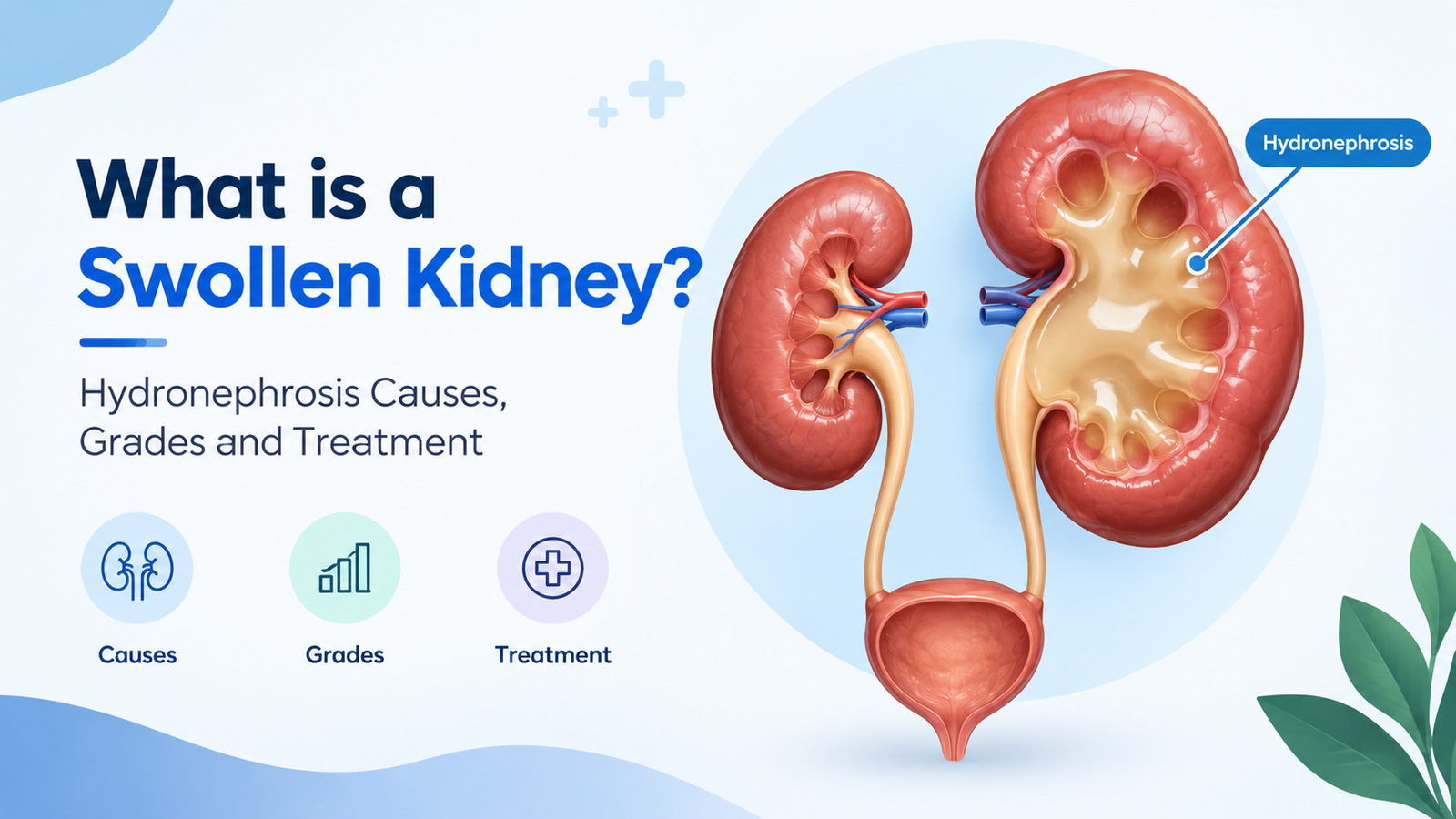
Hydronephrosis is the medical term for a swollen kidney. It happens when urine cannot drain properly out of the kidney and backs up inside its collecting system, stretching the normally slim internal structures.
The kidney filters urine continuously. That urine flows down a thin tube called the ureter into the bladder, through the urethra, and out of the body. Any blockage along this path can cause urine to back up and swell the kidney above it.
Hydronephrosis is not a disease. It is a sign that something downstream is blocking urine flow. The real clinical question is always: what is causing the backup, and how urgently does it need to be relieved?
What Causes Hydronephrosis?
Hydronephrosis is caused by anything that blocks or slows urine flow from the kidney to the outside of the body. The most common causes in adults are:
- Kidney stones stuck in the ureter
- Enlarged prostate (BPH) blocking the bladder outlet
- Ureteral strictures (narrowed segments)
- Tumours in the bladder, prostate, ureter, kidney, or nearby pelvic organs
- Pregnancy, as the growing uterus presses on the ureters
- Vesicoureteral reflux (VUR), where urine flows backwards from the bladder to the kidney
- Blood clots or detached tissue blocking the ureter
- Neurogenic bladder from spinal injury, multiple sclerosis, or diabetes
- Congenital narrowings, usually at the kidney-ureter junction
Each cause changes the urgency and treatment plan.
Kidney Stones
Kidney stones are the single most common cause of unilateral hydronephrosis in adults. A stone moving down the ureter blocks urine flow, and the kidney above swells. Pain is usually severe and comes in waves. Our guide on how long it take to pass a kidney stone explains timelines and treatment.
Enlarged Prostate
An enlarged prostate is the leading cause of bilateral hydronephrosis in men over 50. It presses on the bladder outlet, prevents full emptying, and urine backs up equally into both kidneys. If you have a weak stream, frequent urination, or nocturia, read our enlarged prostate symptoms guide.
Other Causes
Ureteral strictures develop from previous surgery, infection, radiation, or injury. Pelvic tumours and masses from the uterus, ovaries, or bowel can compress the ureters externally. Mild hydronephrosis in pregnancy, especially on the right side, is common and usually harmless.
What Are the Symptoms of a Swollen Kidney?
Symptoms depend on how quickly the swelling developed and how severe it is. Hydronephrosis can be completely silent or dramatically painful.
Common symptoms of hydronephrosis include:
- Flank pain, dull or sharp, below the ribs on the side of the back
- Pain radiating to the lower abdomen, groin, or genitals
- Nausea and vomiting
- Changes in urine output, either less than usual or sudden increased frequency
- Blood in the urine (hematuria)
- Cloudy or foul-smelling urine
- Burning during urination
- Fever and chills if infection is present
- Leg or facial swelling in severe long-standing bilateral cases
A kidney that swells gradually over months may cause no symptoms at all. One that swells acutely, as with a kidney stone, is almost always painful.
Unilateral vs Bilateral Hydronephrosis: What's the Difference?
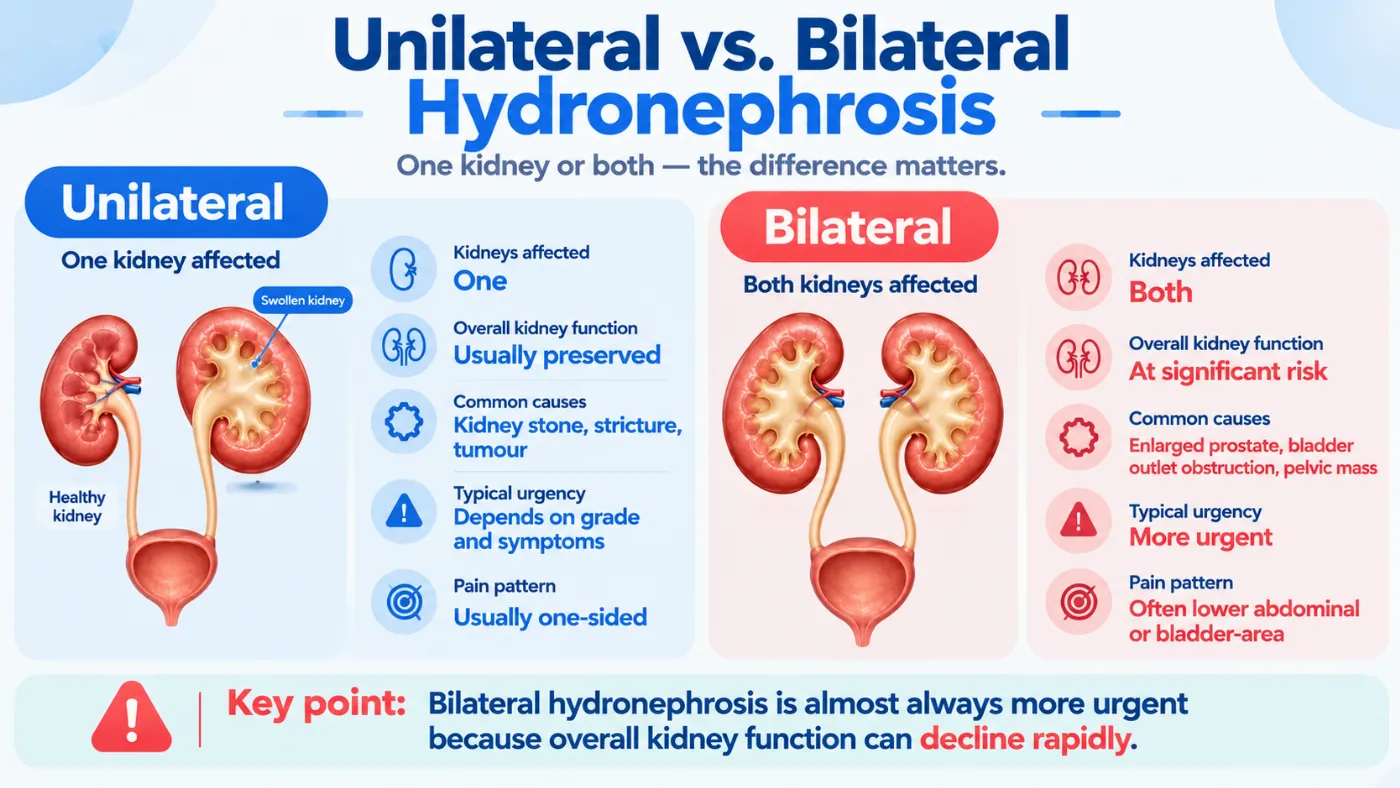
The clinical distinction between one swollen kidney and both affects urgency, likely cause, and treatment.
| Feature | Unilateral (one kidney) | Bilateral (both kidneys) |
|---|---|---|
| Kidneys affected | One | Both |
| Overall kidney function | Usually preserved | At significant risk |
| Common causes | Kidney stone, stricture, tumour | Enlarged prostate, bladder outlet obstruction, pelvic mass |
| Typical urgency | Depends on grade and symptoms | More urgent |
| Pain pattern | Usually one-sided | Often lower abdominal or bladder-area |
Key point: Bilateral hydronephrosis is almost always more urgent because overall kidney function can decline rapidly.
Hydronephrosis Grades Explained: Grade 1 to Grade 4
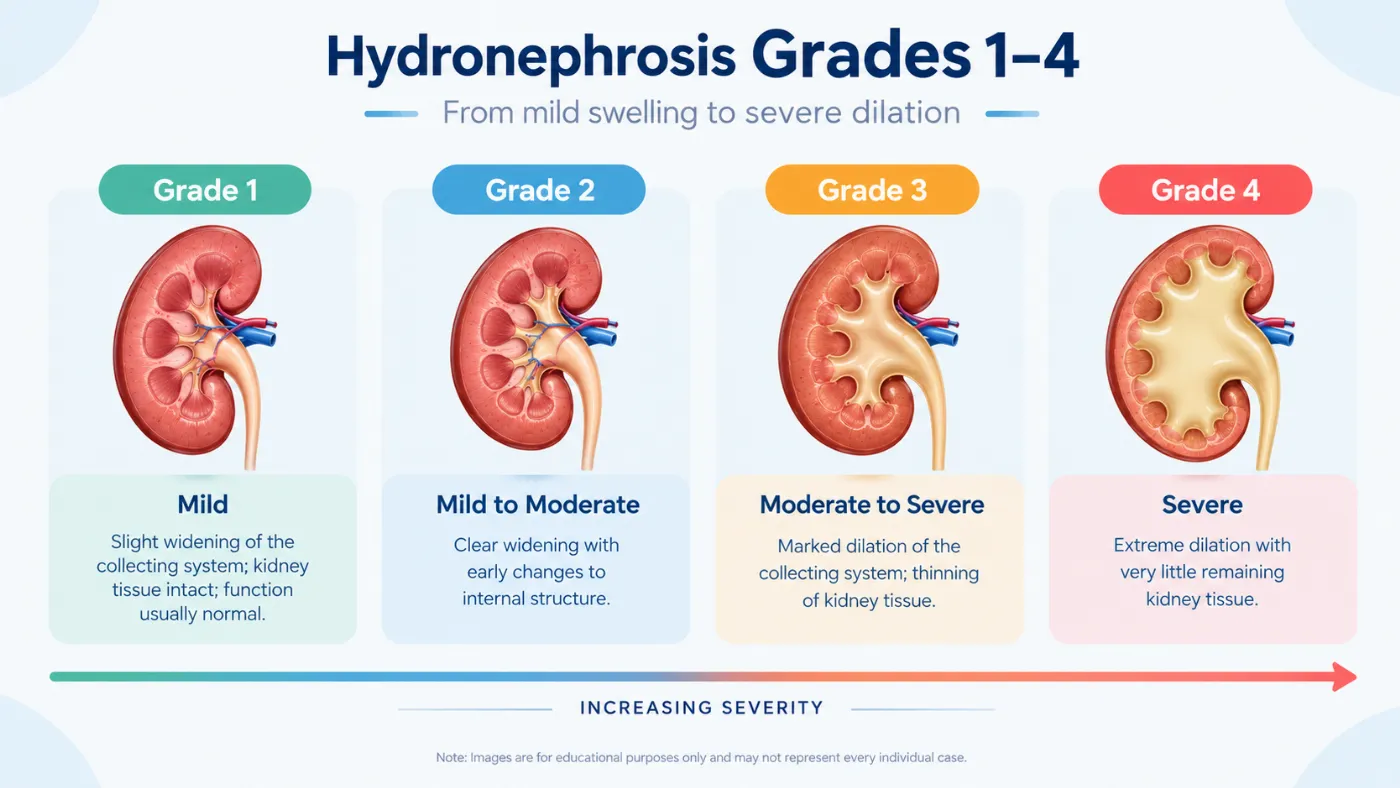
Hydronephrosis is graded on imaging from 1 (mild) to 4 (severe). The grade helps the urologist decide how urgently to treat it.
| Grade | Severity | What it means |
|---|---|---|
| Grade 1 | Mild | Slight widening of the internal collecting system; kidney tissue intact; function usually normal |
| Grade 2 | Mild to moderate | Clear widening with early changes to internal structure |
| Grade 3 | Moderate to severe | Marked widening; kidney tissue starts to thin; function may be affected |
| Grade 4 | Severe | Massive swelling; significant tissue thinning; risk of permanent damage |
Grades 1 and 2 are often incidental findings and may need only monitoring. Grades 3 and 4, especially if bilateral or symptomatic, usually need prompt treatment.
When Is Hydronephrosis a Medical Emergency?
Hydronephrosis is a medical emergency when it occurs with signs of infection, severe pain, or inability to urinate. Seek immediate care if you have any of the following.
Emergency signs of hydronephrosis:
- Fever above 38°C (100.4°F) with flank pain (possible infected, obstructed kidney)
- Severe pain not controlled by medication
- Vomiting that prevents you from keeping fluids down
- A complete inability to urinate, especially with a distended abdomen
- Heavy blood in the urine with clots
- Rapid heart rate, fainting, or cold, clammy skin (signs of shock)
- Known bilateral hydronephrosis with worsening symptoms
An infected, obstructed kidney can become life-threatening within hours. It is one of the few true emergencies in urology.
How Is Hydronephrosis Diagnosed?
Hydronephrosis is diagnosed with a combination of history, examination, blood and urine tests, and imaging, most often an ultrasound. The standard diagnostic workflow is:
- History of pain, urinary symptoms, prior stones, and relevant conditions
- Physical examination of the abdomen and flank
- Urinalysis to check for infection, blood, and other markers
- Blood tests for kidney function (creatinine, eGFR) and infection
- Kidney and bladder ultrasound, the usual first imaging test
- CT scan if the cause is unclear or a stone is suspected
- Cystoscopy or MRI if a tumour or stricture is being evaluated
The grade, pattern (unilateral vs bilateral), and underlying cause together determine the treatment plan.
How Is Hydronephrosis Treated?
Hydronephrosis itself does not need direct treatment. The swelling resolves when the underlying blockage is relieved. Treatment therefore targets the cause.
Treatment by Cause
- Kidney stones: medical expulsive therapy for small stones; ureteroscopy with laser lithotripsy, shock wave lithotripsy, or percutaneous nephrolithotomy for larger ones
- Enlarged prostate: medications first; minimally invasive procedures (UroLift, Rezum, iTind) or tissue-removing options (TURP, HoLEP) if medications are not enough
- Ureteral strictures: endoscopic treatment or surgical repair
- Tumours or masses: treating the underlying cancer, sometimes with urinary diversion
- Pregnancy-related hydronephrosis: usually monitored; drainage only if symptomatic
- Vesicoureteral reflux: antibiotics, bladder training, or surgical correction
Urgent Drainage
When a kidney must be drained quickly, two options are used:
- Ureteral stent: a thin tube passed through the bladder up to the kidney. See our guide on what to expect from a ureteral stent for aftercare.
- Nephrostomy tube: a drain inserted directly into the kidney through the back when a stent is not possible.
Both techniques relieve the backup rapidly and give the kidney time to recover while the cause is treated definitively.
Can Hydronephrosis Be Reversed?
Yes, in most cases. Hydronephrosis is a response to a blockage, so relieving the obstruction usually allows the kidney to recover fully. Recovery depends on three factors:
- How severe the swelling was (grades 1 and 2 recover more completely than grades 3 and 4)
- How long it was present (acute cases of days to weeks recover better than chronic cases of months to years)
- The underlying cause (reversible causes like stones and pregnancy resolve fully; cancer-related obstruction depends on treatment of the tumour)
Prolonged grade 4 hydronephrosis can cause permanent thinning of the kidney tissue and lasting loss of function on that side.
Can You Live Normally With One Damaged Kidney?
Yes. A single healthy kidney is usually enough to maintain full kidney function for life. This is why unilateral hydronephrosis, even when severe, rarely causes overall kidney failure. People who donate a kidney or who are born with one kidney live normal, healthy lives. The focus of treatment for one-sided problems is to save as much function as possible on the affected side, while the other kidney continues working normally.
Expert Care for Kidney Health in Delhi NCR
A swollen kidney is a signal that something downstream needs attention. The sooner the cause is identified, the better the outcome.
Dr. Ashish Saini is a urologist and andrologist at Excel Advanced Urology Center in Greater Kailash 1, New Delhi, whose practice covers the full range of kidney, ureter, and bladder conditions.
- MCh Urology from AIIMS, New Delhi
- MBBS and MS from KGMU, Lucknow
- 15+ years of clinical experience in urology and andrology
- 21,000+ surgeries performed across urological procedures
Hydronephrosis is evaluated with the right imaging, the underlying cause identified promptly, and treatment, whether a stent, a stone procedure, or management of an enlarged prostate, tailored to protect long-term kidney function.
If a scan has shown a swollen kidney, or if you have flank pain, urinary symptoms, or any warning signs above, book an online consultation for a prompt, expert assessment.