

}})
Quick answer: A penile fracture is a tear in the tough fibrous covering of the erect penis, caused by sudden bending or impact during sex, masturbation, or rolling over in sleep. It is a true urological emergency. The classic signs are a popping sound, immediate loss of erection, rapid swelling, and a dark eggplant-like discoloration of the penis. Surgical repair within 24 hours gives the best results and significantly reduces the risk of long-term erectile dysfunction, curvature, or painful erections. Any man with sudden pain or deformity during sex must go to the emergency room immediately.
Penile Fracture at a Glance
- What it is: rupture of the tunica albuginea (the fibrous sheath around the erectile tissue) during an erection
- Classic triad: popping sound, immediate loss of erection, rapid dark swelling
- Emergency? Yes, a true surgical emergency
- Ideal time for surgery: within 24 hours
- Most common cause: vigorous intercourse, particularly with sudden misalignment
- Peak age: 30 to 50 years
- Associated injuries: urethral tear in 10 to 20 percent of cases
What is a Penile Fracture?
A penile fracture is a tear in the tunica albuginea, the strong fibrous sheath that surrounds the erectile chambers (corpora cavernosa) of the penis. Despite the name, there is no bone involved. The penis has no bone, and the "fracture" refers to a rupture of this fibrous covering.
The tunica albuginea becomes thin and taut during an erection. If the erect penis is bent sharply, bumped forcefully, or forced against a hard surface, this stretched fibrous layer can split, releasing blood into the surrounding tissues and causing rapid swelling and bruising.
Penile fracture is uncommon but genuinely serious. Without prompt surgical repair, it can cause lasting problems including erectile dysfunction, visible penile curvature, painful erections, and difficulty urinating.
How Does a Penile Fracture Happen?
A penile fracture usually happens when the erect penis is bent abruptly against a hard structure, most often during sexual activity. The most frequent scenarios are:
- Vigorous intercourse, especially with sudden misalignment or thrusting against the partner's pelvis or perineum
- Woman-on-top sexual position, which carries one of the highest risks due to the angle and force involved
- Rolling over onto the erect penis during sleep
- Masturbation, if the penis is bent forcefully or hit against a hard surface
- Direct trauma to the erect penis from a fall, kick, or accident
- Attempting to force an erection down manually when inconvenient
Any sudden force applied to a fully erect penis in the wrong direction can produce the injury. Patients often remember the exact moment it happened because of the pain, sound, and immediate change in appearance.
What Are the Symptoms of a Penile Fracture?
The symptoms of a penile fracture typically appear immediately and are hard to miss. Most men know something serious has happened within seconds.
Common symptoms of penile fracture:
- An audible popping or snapping sound at the moment of injury
- Immediate loss of erection (detumescence)
- Sharp, intense pain in the penis
- Rapid swelling of the penile shaft
- Dark purple or black bruising across the penis (often called the "eggplant deformity")
- A visible bend or deformity of the penis
- Blood at the tip of the penis if the urethra is also torn
- Difficulty or inability to urinate in some cases
- Blood in the urine (hematuria)
The Classic Diagnostic Triad
The three signs urologists look for together to diagnose penile fracture are: an audible pop or crack, immediate loss of erection, and rapid dark swelling. When all three are present, the diagnosis is almost certain and surgery should not be delayed.
Why is Penile Fracture a Medical Emergency?
Penile fracture is a medical emergency because delayed treatment significantly increases the risk of permanent erectile dysfunction, penile curvature, and painful erections. The window for best outcomes is narrow.
Why timing matters:
- Within 24 hours of injury: surgical repair gives the best functional results
- 24 to 72 hours: repair is still possible but outcomes are less reliable
- After 72 hours: scar tissue has started to form, making repair technically harder and recovery less complete
- Delayed or no treatment: significantly higher rates of long-term ED, curvature, and chronic pain
Many men delay seeking care out of embarrassment. The reality is that urologists see this injury regularly and treat it as a straightforward surgical emergency. Delay is the single most important factor driving a poor outcome.
Penile Fracture vs Other Causes of Penis Pain and Swelling
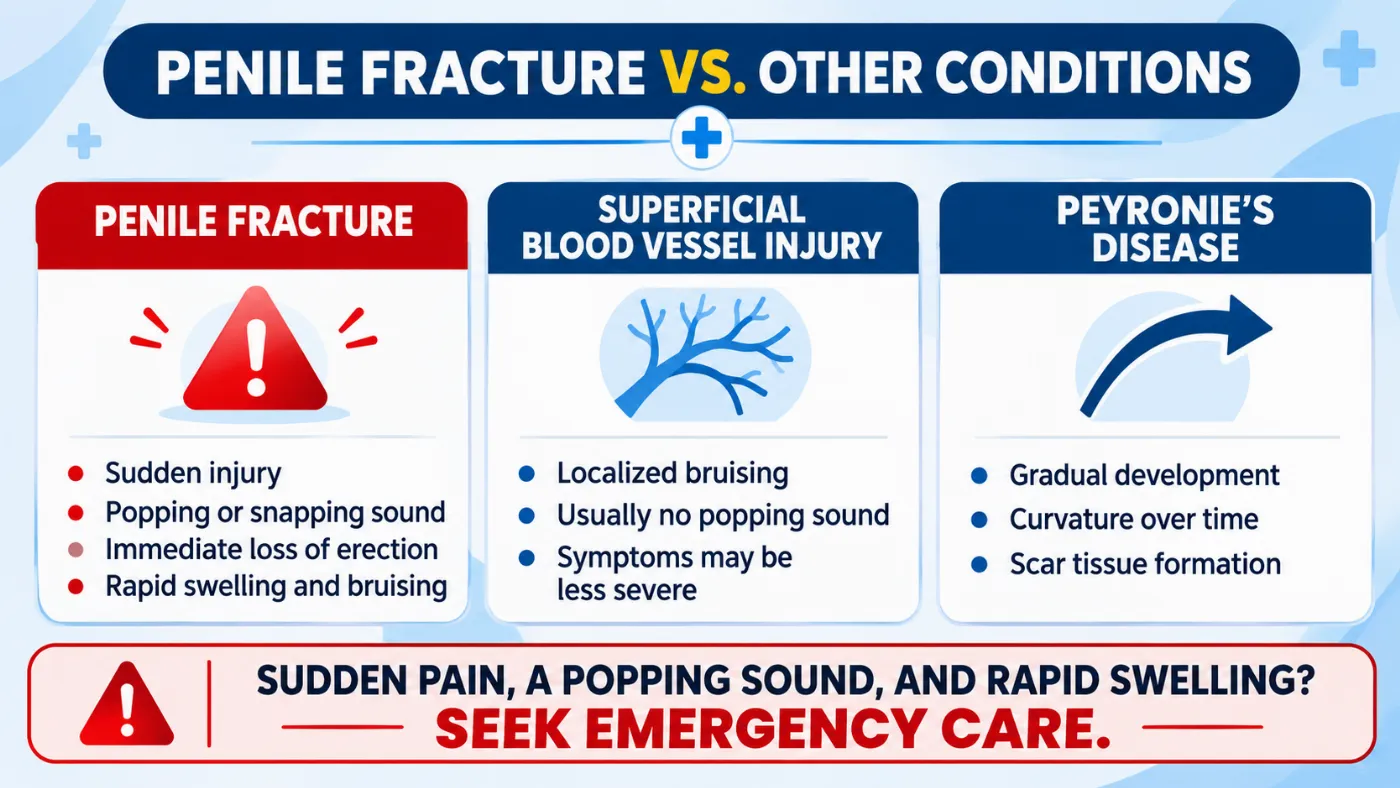
Not every penile injury is a fracture, but any sudden pain and swelling during sex should be assessed urgently. The table below shows how penile fracture differs from other causes of pain and swelling.
| Condition | Mechanism | Pop sound | Loss of erection | Swelling pattern |
|---|---|---|---|---|
| Penile fracture | Rupture of tunica during erection | Yes | Immediate | Rapid, dark, eggplant-shaped |
| Burst superficial blood vessel | Minor vein rupture under skin | No | No | Mild bruise, no deformity |
| Peyronie's disease | Gradual scar tissue buildup | No | No | Slow curvature over months |
| Priapism | Blood trapped in penis | No | No, erection does not resolve | Prolonged painful erection |
| Suspensory ligament strain | Base of penis stretched | No | Not usually | Mild, localized |
| Urethral injury alone | Trauma to urethra | No | Not necessarily | Blood at tip, difficulty urinating |
Key point: The combination of a pop, immediate loss of erection, and rapid dark swelling is specific to penile fracture and demands immediate ER evaluation.
How is Penile Fracture Diagnosed?
Penile fracture is usually diagnosed clinically on examination based on the patient's history and physical signs. Imaging may be used to confirm the location of the tear or rule out other injuries, but should not delay treatment.
Diagnostic workup:
- Clinical history of the exact mechanism of injury and timing
- Physical examination of the penis, scrotum, and perineum
- Scrotal and penile ultrasound to locate the tear if the diagnosis is unclear
- MRI in selected cases, which gives detailed images of the tunica
- Retrograde urethrogram or cystoscopy if urethral injury is suspected (blood at the tip, inability to urinate)
- Urinalysis to check for blood in the urine
Because urethral injury happens alongside penile fracture in 10 to 20 percent of cases, every man with a suspected fracture is evaluated for it.
How is Penile Fracture Treated?
Penile fracture is treated with emergency surgery to repair the torn tunica albuginea. Conservative treatment with ice and compression alone is now known to produce worse long-term outcomes and is no longer standard of care.
Steps of surgical repair:
- Anaesthesia (usually general or spinal)
- An incision to expose the torn area of the tunica
- Evacuation of the blood clot from around the injury
- Suturing the tear closed to restore the structural integrity of the erection chamber
- Repair of any associated urethral injury at the same time
- Dressing and scrotal support to minimize postoperative swelling
The procedure is usually straightforward in experienced hands and typically takes 1 to 2 hours. Most men go home within 24 to 48 hours.
What If Surgery Is Delayed?
Delayed presentation does not mean the injury cannot be treated, but the chances of a perfect result drop with every day. Delayed repairs can still improve function, but rates of residual curvature, erectile dysfunction, and painful erections rise significantly.
What Are the Risks of Delayed or Untreated Penile Fracture?
Untreated or delayed penile fracture is linked to lasting complications that affect both sexual function and self-confidence. The most common long-term problems are:
- Erectile dysfunction, affecting up to 50 percent of men with delayed or untreated repair
- Penile curvature or deformity similar to Peyronie's disease
- Painful erections
- Hard lumps or plaques at the site of the healed tear
- Chronic pain during intercourse
- Urethral stricture if a urethral injury was missed
- Psychological distress and avoidance of intimacy
For a broader look at how erections can be affected after injury or over time, read our article on why do I lose my erection so fast.
What Is Recovery Like After Penile Fracture Surgery?
Most men recover from penile fracture surgery in 4 to 8 weeks, with return to sexual activity typically after 6 weeks. Recovery is usually smooth when surgery is performed early.
Typical recovery milestones:
- Week 1: rest, pain relief, wound care, and avoid any sexual activity or stimulation
- Weeks 2 to 3: gradual return to daily routine; avoid heavy lifting and vigorous exercise
- Weeks 4 to 6: continued healing; follow-up assessment with your urologist
- Week 6 onwards: gradual return to sexual activity after medical clearance
- 3 to 6 months: full functional recovery for most men
Mild bruising and swelling for the first week or two are expected. Fever, worsening pain, discharge, or inability to urinate needs immediate review.
Can You Prevent a Penile Fracture?
Yes, several practical precautions can reduce the risk of penile fracture during sex. While the injury can happen in otherwise healthy men without obvious warning, awareness helps.
Practical ways to reduce risk:
- Avoid sudden, hard thrusting, especially when positions make misalignment likely
- Communicate with your partner about pacing and comfort
- Pause and reposition carefully rather than forcing a bend during intercourse
- Use adequate lubrication
- Be careful in positions with limited visibility of alignment, such as rear-entry or woman-on-top
- Do not force an erection downwards by hand
- Avoid attempts to manually "break" an erection when it is inconvenient
Preventive awareness matters because many fractures happen in a single unlucky moment during otherwise normal intimacy.
When to Go to the Emergency Room
Go to the emergency room immediately after any penile injury that causes sudden pain, a popping sound, loss of erection, or visible swelling and bruising. Do not wait, do not try home remedies, and do not let embarrassment delay care.
Go to the ER right away if you have:
- A popping or snapping sound during sex or masturbation
- Sudden loss of an erection with pain
- Rapid swelling or bruising of the penis
- A visible bend or deformity of the penis
- Blood at the tip of the penis
- Inability to urinate after a penile injury
- Severe penile pain after any sudden force
Prompt care is the single most important factor in preserving long-term sexual function.
Expert Care for Penile Fracture and Emergency Andrology in Delhi NCR
Penile fracture is a sensitive, time-critical injury. Prompt, experienced urological care is the difference between full recovery and lifelong complications.
Dr. Ashish Saini is a urologist and andrologist at Excel Advanced Urology Center in Greater Kailash 1, New Delhi, whose practice covers the full spectrum of male urological and reproductive emergencies, including penile trauma, erectile dysfunction, and Peyronie's disease.
- MCh Urology from AIIMS, New Delhi
- MBBS and MS from KGMU, Lucknow
- 15+ years of clinical experience in urology and andrology
- 21,000+ surgeries performed across urological procedures
This depth of training means penile fracture is recognised quickly, surgery is performed within the critical window where possible, and long-term sexual function is actively protected throughout recovery.
If you have suffered a penile injury or want to discuss recovery after a previous one, book an online consultation for a confidential, expert evaluation.