
}})
Choosing the right circumcision method is one of the most important decisions a patient or parent can make. Whether it is for medical, religious, or cultural reasons, the technique matters - it directly affects pain, healing time, cosmetic outcome, and risk of complications. With modern medicine advancing rapidly, laser circumcision has emerged as a popular alternative to the age-old traditional surgical method.
But which one is actually better? In this guide, we break down laser circumcision vs traditional circumcision across all key factors so you can make a well-informed choice.
What is Traditional Circumcision?
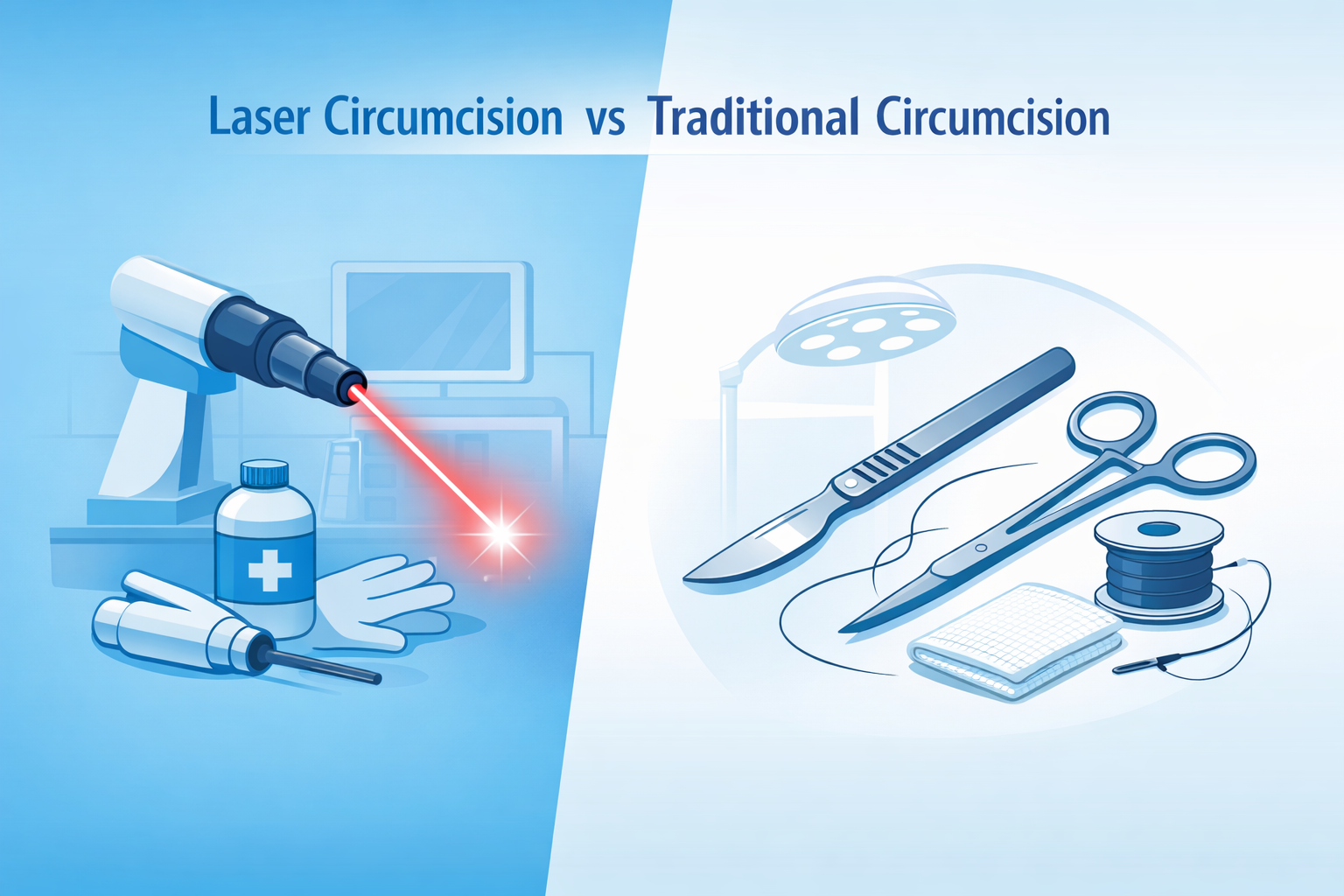
Traditional circumcision is one of the oldest and most widely practised surgical procedures in the world. It involves the physical removal of the foreskin using a scalpel or surgical scissors. The procedure is typically performed under local or general anaesthesia, and the incision is closed with dissolvable stitches.
How the procedure works:
- The genital area is cleaned, and anaesthesia is administered
- A surgeon uses a scalpel or surgical scissors to cut and remove the foreskin
- Bleeding is controlled using sutures or bipolar cautery
- The wound is dressed, and the patient is monitored before discharge
Traditional circumcision is available at virtually every hospital or urology clinic worldwide, making it the most accessible option. It has a well-established safety profile, performed successfully for decades by experienced surgeons. However, it causes more tissue disruption, which can lead to greater postoperative discomfort and a longer healing period.
Common medical reasons for circumcision include:
- Phimosis (a tight foreskin that cannot retract)
- Paraphimosis
- Recurrent balanitis (inflammation of the glans)
- Urinary tract infection prevention
- Penile hygiene improvement
What is Laser Circumcision?

Laser circumcision is a modern, minimally invasive technique that uses a high-energy laser beam - most commonly a CO2 (carbon dioxide) laser - to remove the foreskin. The laser cuts tissue with precision while simultaneously cauterising (sealing) the blood vessels, which dramatically reduces bleeding during the procedure.
How the procedure works:
- The area is cleaned, and local anaesthesia is administered
- A specialised laser makes precise incisions along a marked circumferential line
- The laser seals blood vessels as it cuts, minimising bleeding
- Wound edges are approximated with absorbable sutures in most cases
- Postoperative care involves keeping the area clean and applying prescribed ointments
Laser circumcision has gained significant acceptance in urology because of its accuracy, reduced trauma to surrounding tissue, and cleaner cosmetic outcomes. It requires specialised equipment and a trained surgeon, which is why it may not be available in every healthcare facility - particularly in smaller towns or rural areas.
Laser Circumcision vs Traditional Circumcision: Key Differences

1. Pain Levels
Laser circumcision is widely regarded as less painful than the traditional approach. A clinical study published in Research and Reports in Urology involving 482 patients found that the CO2 laser technique was associated with significantly lower pain scores at both 1 day and 7 days postoperatively compared to the conventional method.
The reason is straightforward: the laser cauterises nerve endings as it cuts, thereby reducing the pain signals sent to the brain. Traditional circumcision, while performed under anaesthesia, causes more physical tissue disruption, resulting in greater soreness once the anaesthesia wears off.
- Laser circumcision: Low postoperative pain, faster pain resolution
- Traditional circumcision: Moderate to higher pain, managed with prescribed medication
2. Bleeding and Haemostasis
One of the most clinically significant advantages of laser circumcision is its haemostatic (blood-stopping) capability. The laser beam seals small blood vessels as it makes the incision, meaning far less intraoperative and postoperative bleeding.
In traditional circumcision, bleeding control depends on sutures and bipolar cautery - effective, but more reactive. Studies show no significant difference in infection rates between the two methods, but laser circumcision consistently demonstrates superior blood management.
- Laser circumcision: Minimal bleeding due to simultaneous cauterisation
- Traditional circumcision: Requires active haemostasis via sutures or cautery
3. Recovery Time

Recovery is one of the biggest practical concerns for patients. Laser circumcision generally offers a faster return to normal activities due to less tissue damage and reduced swelling.
- Laser circumcision recovery: Most patients resume light activities within a few days. Significant healing typically occurs within 1–2 weeks, with complete recovery in 3–4 weeks.
- Traditional circumcision recovery: Initial recovery spans 1–2 weeks, but full healing - including resolution of swelling and scar tissue - may take several weeks to a few months.
The reduced postoperative oedema (swelling) after laser circumcision is a well-documented advantage, making the healing phase noticeably more comfortable.
4. Cosmetic Outcome
For many patients, cosmetic appearance matters. Laser circumcision consistently produces superior cosmetic results. The precision of the laser allows for a cleaner, more even incision line, resulting in minimal and linear scarring.
A study comparing CO2 laser vs conventional technique found that a linear surgical scar developed in 94.9% of laser circumcision patients compared to 61.3% in the traditional group - a significant cosmetic advantage.
- Laser circumcision: Cleaner incision, minimal and linear scarring
- Traditional circumcision: Variable cosmetic results depending on surgical skill
5. Risk of Infection
Both methods carry a low risk of infection when performed by experienced surgeons in sterile conditions. Clinical data show no statistically significant difference in infection rates between the two techniques. However, the laser's cauterising effect creates a natural sterile barrier that may offer an added layer of protection.
Good postoperative care - including wound hygiene, prescribed antibiotic ointments, and regular follow-up visits - is essential regardless of the method chosen.
6. Cost
Cost is a deciding factor for many patients.
- Traditional circumcision is generally less expensive because it uses standard surgical instruments available at most facilities.
- Laser circumcision costs more due to specialised laser equipment and the additional training required for the surgeon.
The price difference varies by geography and healthcare facility.
Expert tip: When considering cost, also factor in indirect costs - pain medication, additional clinic visits, and time off work during recovery. Laser circumcision may offer better long-term value despite the higher upfront cost.
7. Availability
Traditional circumcision is available at virtually every urology department and general surgical facility globally. Laser circumcision, while increasingly common, is still limited to hospitals and clinics equipped with CO2 or similar laser technology, which may not be accessible in rural or semi-urban settings.
Quick Comparison Table
Who Should Choose Laser Circumcision?
Laser circumcision is a strong fit if:
- You want minimal pain and a faster recovery
- Cosmetic outcome is important to you
- You have access to a facility with laser equipment
- You are comfortable with the higher cost
- You are an adult undergoing elective circumcision for medical or hygiene reasons (such as phimosis treatment)
Who Should Choose Traditional Circumcision?
Traditional circumcision remains an excellent option if:
- Laser equipment is not available in your area
- Cost is a primary constraint
- The procedure is being performed on a newborn or infant (where traditional methods like Gomco or Mogen clamps are well-established)
- Your surgeon is highly experienced in conventional techniques
Expert Insights: What the Research Says
Urological research consistently supports laser circumcision as a technically superior option for adult patients - particularly when operative time, pain management, and cosmetic appearance are priorities. A comprehensive review of studies (published between 2001 and 2022 in PubMed, Cochrane, and Embase) concluded that laser circumcision provides superior outcomes in terms of operative time and postoperative complication rate compared to traditional circumcision.
That said, experts agree on one critical point: the skill and experience of the surgeon matter more than the technique itself. A highly experienced surgeon performing traditional circumcision will produce better outcomes than an inexperienced one using laser equipment.
Always consult a qualified urologist before making a decision. Personalised medical advice is irreplaceable.
Conclusion
When comparing laser circumcision vs traditional circumcision, laser circumcision offers clear advantages in pain control, recovery time, bleeding management, and cosmetic outcome. Traditional circumcision, however, remains a clinically proven, widely accessible, and cost-effective option that continues to serve millions of patients worldwide.
Key takeaways:
- Laser circumcision causes less postoperative pain and heals faster
- Traditional circumcision is more affordable and universally available
- Both methods are safe when performed by experienced surgeons in sterile settings
- Cosmetic results are consistently better with laser circumcision
- Your final choice should be guided by medical advice, personal needs, availability, and budget
Before deciding, schedule a consultation with a qualified urologist who can assess your specific condition and recommend the most appropriate circumcision method for you.