
}})
Benign Prostatic Hyperplasia, commonly known as BPH or enlarged prostate, is a condition that affects many men as they grow older. It does not appear suddenly. Instead, the prostate slowly enlarges over time. In the beginning, symptoms may be mild. A man might notice a slightly weak urine stream or a need to urinate more often at night.
As the condition progresses, the symptoms can become more troublesome. Some men begin to strain while urinating. Others feel that their bladder never empties completely. Frequent nighttime urination may disturb sleep, and daily activities can become inconvenient.
The prostate sits just below the bladder and surrounds the urethra, which is the tube that carries urine out of the body. When the prostate enlarges, it presses against this tube. The urine passage becomes narrower.
Think of it like squeezing a garden hose. Water can still pass through, but the flow becomes weaker. In the same way, when the prostate presses on the urethra, urine flow slows down.
Doctors usually begin treatment with medications or lifestyle changes. But sometimes these treatments are not enough. When symptoms become severe or complications develop, surgery may be recommended.
One of the most common surgical treatments for BPH is TURP surgery, also known as Transurethral Resection of the Prostate. Understanding when TURP is recommended for BPH helps patients know when surgery may become necessary.
Understanding BPH and Its Symptoms
The prostate gland plays an important role in the male reproductive system. It produces fluid that helps nourish and transport sperm. In younger men, the gland is small, roughly the size of a walnut.
With age, hormonal changes can cause the prostate to enlarge. This enlargement is not cancerous, but it can still create problems by pressing against the urethra.
As the urethra becomes compressed, urine cannot flow as easily from the bladder. The bladder must push harder to empty.
Over time, this pressure can lead to several symptoms. Many men notice a weak urine stream. Some find it difficult to start urination even when they feel the urge to go. Others experience frequent urination, especially during the night.
These symptoms are often called lower urinary tract symptoms, or LUTS.
For some men, these symptoms remain mild for many years. In others, the symptoms gradually worsen and begin to affect daily life.
What Is TURP Surgery?
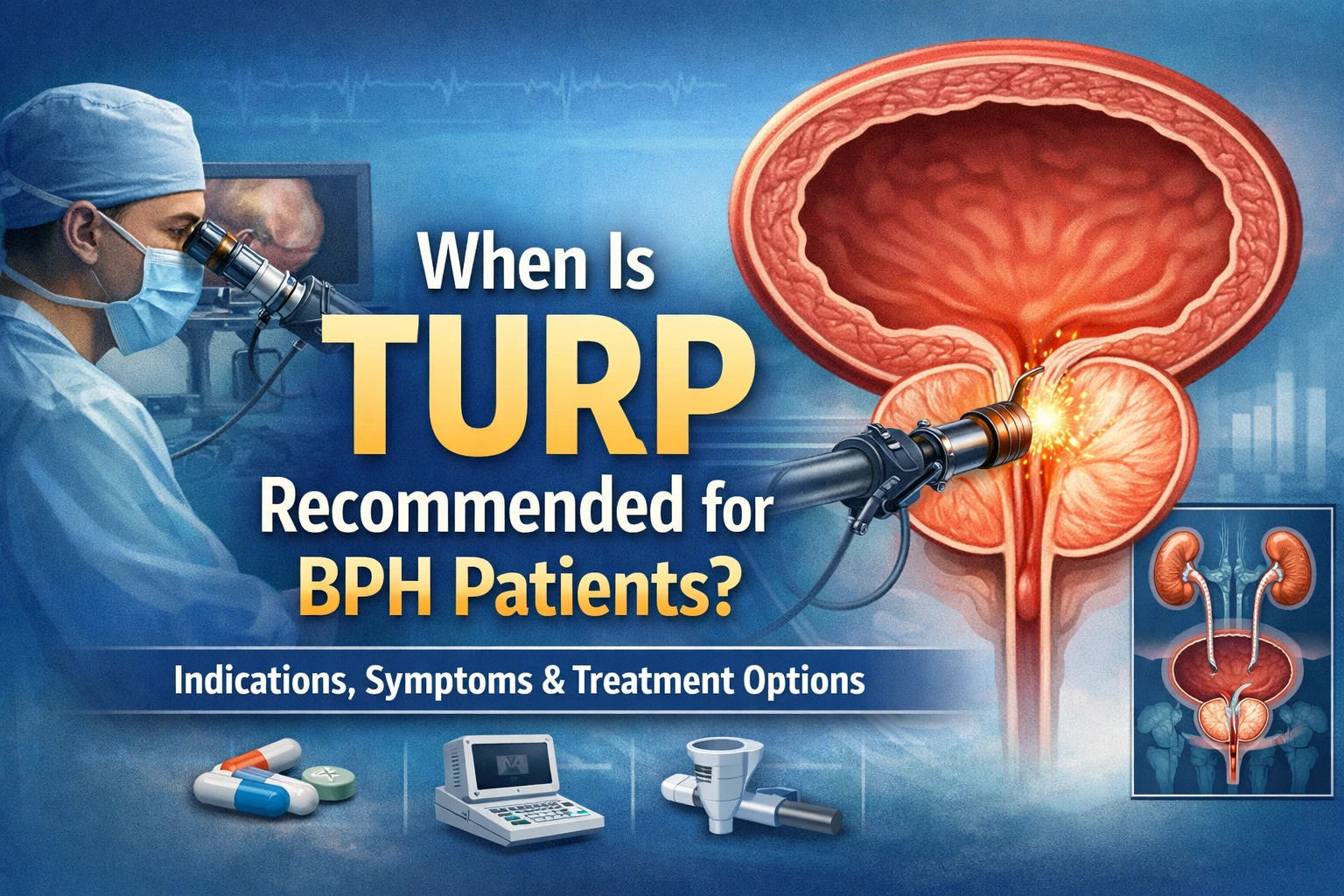
TURP, short for Transurethral Resection of the Prostate, is a surgical procedure designed to relieve the blockage caused by an enlarged prostate.
Unlike traditional open surgery, TURP does not require external cuts on the body. Instead, the surgeon works through the urethra using a special instrument called a resectoscope.
The resectoscope is a thin tube equipped with a camera and a tiny electrical loop. This instrument allows the surgeon to see the prostate clearly while removing excess tissue.
During the procedure, the surgeon carefully trims away the part of the prostate that is blocking the urethra. Once the obstructing tissue is removed, the urine passage becomes wider.
Imagine clearing debris from a narrow tunnel. Once the blockage is gone, traffic can move freely again. TURP works in a similar way by clearing the obstruction inside the prostate.
The procedure is usually performed under spinal or general anesthesia and typically takes about one hour.
Why TURP Has Long Been a Standard Treatment
For decades, TURP has been considered one of the most reliable treatments for moderate to severe BPH.
Doctors often refer to it as the gold standard treatment because it has been studied extensively and has consistently produced good results.
Many patients experience significant improvement in urine flow after surgery. Symptoms such as frequent urination, weak stream, and incomplete bladder emptying often improve dramatically.
Because the obstructing tissue is removed, the results tend to last for many years.
Although newer treatments have been developed, TURP remains a widely trusted option for patients whose symptoms are severe.
When Is TURP Recommended for BPH?
Doctors recommend TURP when symptoms become severe or when complications develop.
In most cases, patients begin treatment with medications. Drugs such as alpha blockers relax the muscles of the prostate, making it easier for urine to pass. Other medications shrink the prostate over time.
For many men, these medications control symptoms effectively. However, some patients continue to experience bothersome symptoms despite treatment.
When medications no longer provide relief, surgery may become necessary.
The decision to recommend TURP usually depends on several factors. These include symptom severity, the presence of complications, and how much the condition affects the patient’s quality of life.
Severe Urinary Symptoms
One of the most common reasons doctors recommend TURP is severe urinary symptoms.
A weak urine stream may require significant straining to empty the bladder. Some men must visit the bathroom many times during the day. Others wake up multiple times during the night.
Over time, these symptoms can disrupt sleep and daily activities.
Imagine waking up every hour during the night just to urinate. The lack of sleep can lead to fatigue, irritability, and reduced concentration during the day.
When symptoms reach this level, surgery may provide lasting relief.
When Medications Stop Working
Medication is often the first step in managing BPH.
Doctors usually prescribe drugs that relax prostate muscles or reduce gland size. While these medications help many patients, they do not work for everyone.
Some men continue to experience symptoms even after months of treatment. Others develop side effects such as dizziness, fatigue, or sexual problems.
When medications fail to improve symptoms, doctors may recommend TURP to remove the obstruction directly.
Urinary Retention
Urinary retention occurs when the bladder cannot empty properly.
In severe cases, a person may be unable to urinate at all. This condition can be extremely uncomfortable and may require immediate medical attention.
Doctors sometimes insert a catheter to drain the bladder. However, if urinary retention happens repeatedly, it suggests that the prostate obstruction is severe.
In these situations, TURP can help restore normal urine flow.
Recurrent Urinary Infections
When urine remains trapped in the bladder, bacteria can multiply easily. This increases the risk of urinary tract infections.
Repeated infections can cause discomfort, fever, and other health problems.
If BPH leads to frequent infections, doctors may recommend surgery to remove the blockage and allow the bladder to empty properly.
Bladder Stones and Kidney Problems
Untreated BPH can sometimes lead to additional complications.
When urine remains in the bladder for long periods, minerals may crystallize and form bladder stones. These stones can cause pain and further block urine flow.
In severe cases, pressure from the blocked bladder may affect the kidneys. Over time, this can lead to kidney damage.
When complications like these occur, surgery becomes necessary to relieve the obstruction.
Does Prostate Size Determine the Need for TURP?
Many patients assume that prostate size alone determines whether surgery is needed. In reality, the decision is more complex.
Doctors evaluate several factors before recommending TURP. These include the severity of symptoms, urine flow rate, bladder function, and the presence of complications.
Some men with moderately enlarged prostates experience severe symptoms. Others with larger prostates may have fewer complaints.
Because of this, treatment decisions are based on a complete evaluation rather than size alone.
TURP Compared With Other Treatments
Several newer procedures have been developed for treating BPH.
Minimally invasive treatments such as UroLift, Rezum, and iTind aim to reduce symptoms with shorter recovery times.
Laser procedures such as HoLEP remove prostate tissue using advanced laser technology.
These options may be suitable for certain patients, especially those with mild to moderate symptoms.
However, TURP may still be recommended when symptoms are severe or when prostate anatomy makes minimally invasive procedures less effective.
Tests Performed Before TURP
Before recommending surgery, doctors perform several tests to understand the condition better.
These tests may include urine flow measurements, ultrasound imaging, blood tests, and cystoscopy to examine the urinary tract.
These evaluations help confirm the diagnosis and determine the most appropriate treatment.
Recovery After TURP
Recovery from TURP usually takes a few weeks.
Patients often stay in the hospital for one to three days after surgery. A catheter may be placed temporarily to allow urine to drain while the prostate heals.
In the first few weeks, mild burning during urination or small amounts of blood in the urine may occur. These symptoms gradually improve as healing progresses.
Most patients return to normal activities within two to four weeks.
As recovery continues, urine flow improves and symptoms become much easier to manage.
Conclusion
Benign Prostatic Hyperplasia is a common condition that can significantly affect urinary function and quality of life.
While medications help many patients, surgery may become necessary when symptoms become severe or complications develop.
TURP remains one of the most effective treatments for relieving prostate obstruction and improving urine flow.
Understanding when TURP is recommended for BPH patients allows men to recognize when medical therapy may no longer be enough and when surgical treatment may provide lasting relief.
Consulting a qualified urologist ensures that each patient receives the treatment best suited to their condition and long-term health.