
}})
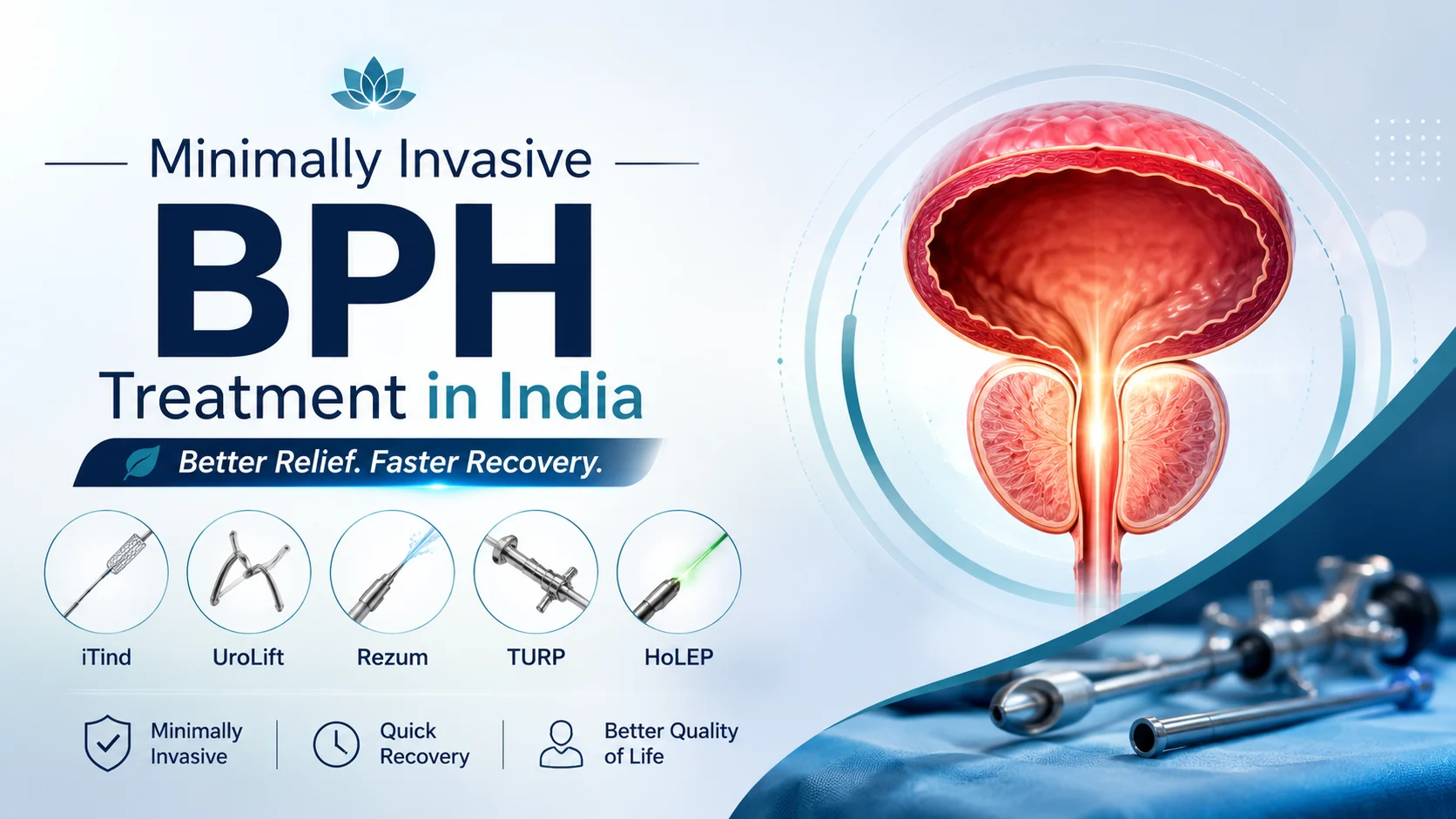
The main minimally invasive and non-surgical treatments for an enlarged prostate are iTind, UroLift, Rezum, TURP, and HoLEP. iTind, UroLift, and Rezum are the gentlest options for smaller or moderate prostates and preserve sexual function. TURP remains the gold standard for moderate enlargement, while HoLEP is the strongest choice for large prostates. The right procedure depends on your prostate size, symptom severity, and personal priorities such as recovery speed and fertility.
If your enlarged prostate is disrupting your sleep and your days, and tablets are no longer doing enough, the good news is that surgery is not your only option. Modern urology offers a whole spectrum of minimally invasive treatments that relieve symptoms with little downtime, often without a hospital stay, and frequently without the sexual side effects men fear most.
This guide walks through all five leading options available in India, gives you a master comparison table, and explains how a urologist actually decides between them, so you can have a focused conversation at your consultation.
Understanding an Enlarged Prostate (BPH)
An enlarged prostate, known medically as benign prostatic hyperplasia or BPH, is one of the most common conditions in ageing men. The prostate sits below the bladder and wraps around the urethra, the tube that carries urine out of the body. As the gland grows, it squeezes the urethra and obstructs urine flow, a problem doctors call bladder outlet obstruction.
This pressure produces the familiar lower urinary tract symptoms, or LUTS:
- A weak or interrupted urine stream
- Needing to urinate often, especially at night (nocturia)
- A sudden, urgent need to go
- Difficulty starting urination, known as hesitancy
- A feeling that the bladder never empties fully
Many men control these symptoms with medication such as alpha-blockers for years. When the tablets stop working, cause troublesome side effects, or the bladder starts to suffer, it is time to look at procedures. The choices fall into two broad groups: minimally invasive treatments that reposition or shrink tissue, and tissue-removing options that deliver stronger, longer-lasting relief.
The Five Leading Treatment Options
1. iTind
iTind stands for temporary implantable nitinol device. A small self-expanding device is placed inside the prostate using a flexible cystoscope, usually under local anaesthesia. Over five to seven days it gently reshapes the urinary channel, then it is removed in a quick clinic visit, leaving nothing behind.
It is one of the gentlest options, uses no heat and no cutting, and usually needs no catheter. The trade-off is durability, with relief lasting around three years on average, though it can be repeated. Full details are on our iTind procedure page.
2. UroLift
UroLift is a prostatic urethral lift. Instead of cutting tissue, the surgeon places tiny permanent implants that hold the enlarged prostate lobes apart, opening the channel for urine. It is often done as a day-care procedure and preserves ejaculation in the vast majority of men, which makes it popular with younger patients. Read more on our UroLift procedure page.
3. Rezum
Rezum is a water vapour therapy. Short bursts of sterile steam are released into the overgrown prostate tissue, gently destroying the excess cells. Over the following weeks the body reabsorbs them, shrinking the prostate and easing the obstruction. Because it actually reduces prostate volume, relief tends to last longer than iTind, in the range of five to seven years. Our Rezum page covers it in full.
4. TURP
Transurethral resection of the prostate, or TURP, has been the benchmark BPH surgery for almost a century and is still called the gold standard. Using a resectoscope passed through the urethra, the surgeon trims away the obstructing tissue, opening a wide channel. It delivers powerful, durable flow improvement and suits moderate enlargement well, though it carries a higher chance of retrograde ejaculation and a longer recovery than the gentler options.
5. HoLEP
Holmium laser enucleation of the prostate, or HoLEP, uses a laser to enucleate and remove obstructing tissue with minimal blood loss. It is the strongest choice for large and very large prostates, often achieving results that hold for well over a decade. HoLEP can also clear bladder stones during the same procedure, which is a real advantage for some men. You can explore where it fits on our prostate disease treatment page.
Master Comparison Table
The table below puts all five options side by side across the factors patients ask about most.
How a Urologist Chooses the Right Procedure
There is no single best treatment for everyone. The right choice is the one that matches your prostate and your priorities. In practice, a specialist weighs three things in order.
Prostate Size First
Size usually narrows the field quickly:
- Small to moderate prostates can be treated well with iTind, UroLift, or Rezum, which are the gentlest options with the least downtime.
- Moderate prostates are a classic fit for TURP, which removes tissue and gives durable relief.
- Large and very large prostates are best treated with HoLEP, which removes the most tissue with minimal bleeding.
Symptom Severity Next
Mild to moderate symptoms often respond well to a minimally invasive option, sparing you a hospital stay. Severe blockage, repeated urinary retention, or a struggling bladder usually calls for a tissue-removing procedure like TURP or HoLEP that opens the channel decisively.
Your Priorities Last
Once size and severity have shaped the shortlist, your own preferences decide the final choice:
- Protecting fertility and ejaculation: iTind, UroLift, and Rezum are far gentler here than TURP or HoLEP.
- Avoiding a catheter: iTind usually needs none, which appeals to many men.
- Longest possible relief: HoLEP and TURP win on durability.
- Fastest return to routine: the minimally invasive trio gets most men back to normal within days.
- Avoiding general anaesthesia: iTind, UroLift, and Rezum can often be done under local anaesthesia.
This is exactly why a careful evaluation matters. Two men with the same symptoms can need very different procedures once prostate size, anatomy, and personal goals are factored in.
Comparing the Options in More Detail
If you want to go deeper on any pairing, dedicated comparisons make the trade-offs clearer. Our UroLift vs TURP guide weighs the gentlest implant option against the gold standard, while iTind vs Rezum compares the two newest minimally invasive treatments head-to-head. Reading these alongside this overview helps you arrive at your consultation already knowing the right questions to ask.
What Does BPH Treatment Cost in India?
One of the biggest reasons men from across India and abroad choose treatment here is value. The same advanced procedures available in the UK or USA are offered at a fraction of the cost, without compromising on quality.
Pricing varies widely with the procedure, the device used, the hospital, the surgeon, and any sedation or follow-up involved. Minimally invasive options that use a device or steam often carry the cost of that technology, while laser procedures like HoLEP reflect the equipment and expertise involved. Because the range is broad and depends so heavily on your specific case, the most reliable figure always comes from a personalised consultation rather than a generic online estimate. What every option shares is a far shorter, gentler path to relief than open surgery.
Expert Care for Enlarged Prostate in Delhi NCR
When a decision spans this many options, experience is what turns a confusing choice into a clear one. Dr. Ashish Saini is a urologist and andrologist at Excel Advanced Urology Center in Greater Kailash 1, New Delhi, who has spent his career treating the full range of prostate and urinary conditions.
- MCh Urology from AIIMS, New Delhi
- MBBS and MS from KGMU, Lucknow
- 15+ years of clinical experience in urology and andrology
- 21,000+ surgeries performed across urological procedures
This depth of training means your enlarged prostate is assessed properly, with the right tests and an honest discussion about which of these five options truly fits you, rather than a one-size-fits-all recommendation.
If your symptoms are disturbing your sleep, your confidence, or your daily routine, you do not have to simply live with them. Book an online consultation to find out which minimally invasive option is the best path forward for you.