
}})
KEY TAKEAWAYS
Before you read the full comparison, here are the most important things to know:
- TURP is the gold standard BPH surgery with decades of data, high efficacy, and proven long-term results.
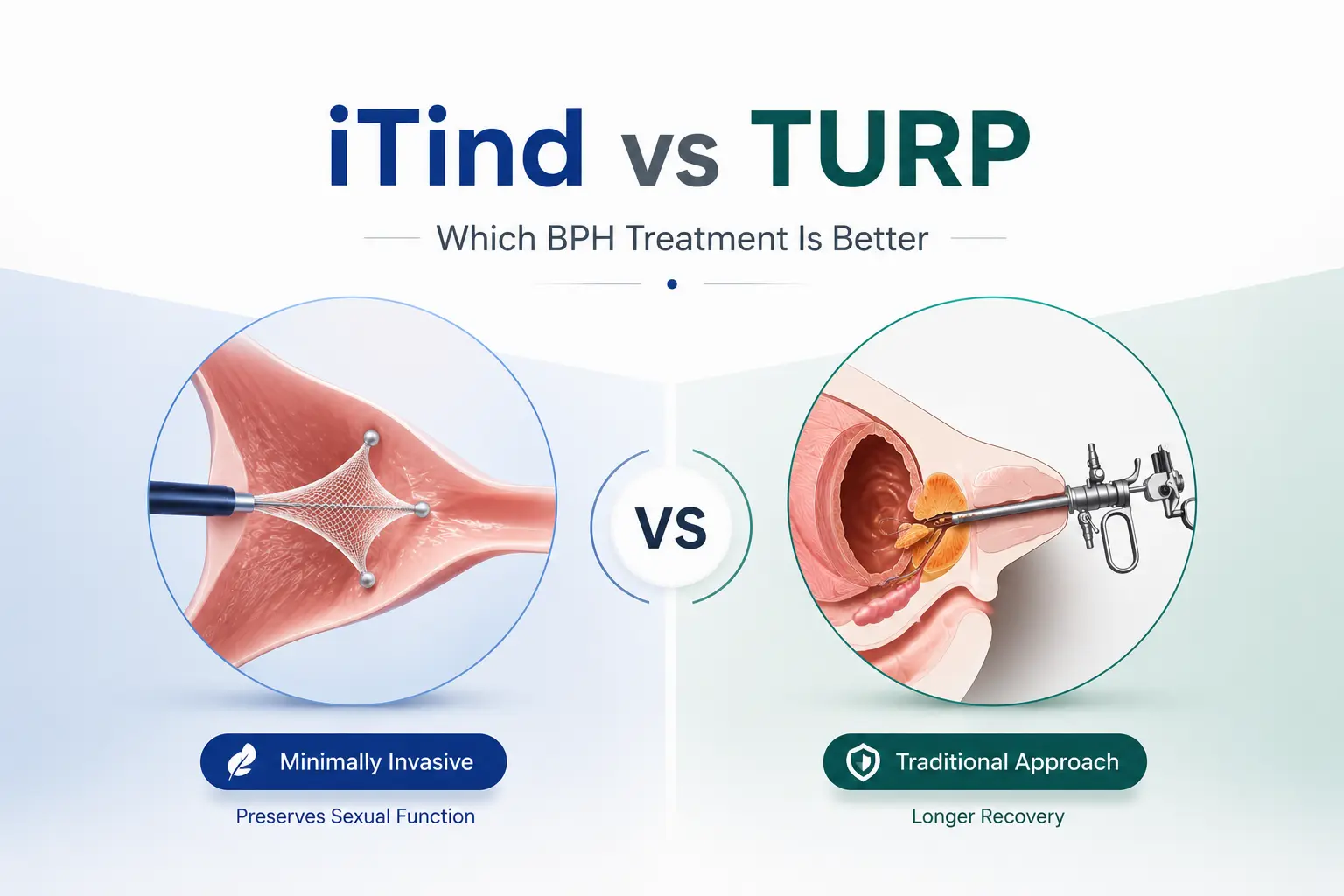
- iTind is a minimally invasive BPH treatment that uses a temporary nitinol device to reshape the prostate, with no permanent implant left behind.
- TURP requires general or spinal anesthesia; iTind can often be done under local anesthesia or mild sedation.
- TURP recovery typically takes 4-6 weeks; iTind patients often return to normal activities much sooner.
- Retrograde ejaculation occurs in up to 65-90% of TURP patients but is significantly less common after iTind.
- iTind better preserves sexual function for most men compared to TURP.
- TURP produces larger, more durable Qmax and IPSS improvements and is better suited for large prostates.
- iTind has a higher long-term retreatment rate than TURP, meaning some men may need additional treatment later.
- iTind is performed as an outpatient procedure, while TURP usually requires a 1-3 day hospital stay.
- Insurance and Medicare coverage for iTind has been expanding, but is not yet as universally covered as TURP.
TURP is the long-standing gold standard for an enlarged prostate and gives the strongest, most durable results, especially for large prostates, but it needs spinal or general anaesthesia, a 1 to 3 day hospital stay, and 4 to 6 weeks of recovery, with a high rate of retrograde ejaculation. iTind is minimally invasive, done mostly under local anaesthesia with same-day discharge, recovery in a few days, and far better preservation of sexual function, though it suits small to medium prostates and has a higher long-term retreatment rate. The right choice depends on prostate size, symptom severity, and personal priorities.
If you have been told you have an enlarged prostate, you are not alone. Benign prostatic hyperplasia, or BPH, affects about half of men in their 50s and up to 90% of men in their 80s. At some point, medication stops being enough. Your doctor brings up surgery.
And suddenly you are staring down two very different paths: TURP, the procedure doctors have trusted for decades, and iTind, a newer approach that sounds almost too simple to be real.
This article walks you through both. Side by side. In plain language. So you can have a real conversation with your urologist instead of nodding along, wondering what they actually mean.
What is BPH and Why Does Treatment Matter?
BPH stands for benign prostatic hyperplasia. "Benign" means it is not cancer. "Hyperplasia" means the tissue is growing too much. As the prostate grows, it squeezes the urethra, the tube that carries urine out of the body.
The result? Weak urine stream. Frequent trips to the bathroom at night. A feeling that your bladder never fully empties. These are called lower urinary tract symptoms, or LUTS.
Doctors measure how bad these symptoms are using the IPSS score (International Prostate Symptom Score). A high IPSS means severe symptoms. A good treatment brings that score down significantly.
Symptoms That Push Men Toward Surgery

Most men start with medication, like alpha-blockers or 5-alpha-reductase inhibitors. But for many, the drugs stop working or cause side effects of their own. That is when BPH surgical treatment becomes the next step.
The two main choices today are TURP and iTind.
What is TURP? The Long-Standing Gold Standard
TURP (transurethral resection of the prostate) has been the standard surgical option for BPH for more than 70 years. Think of it like a plumber cutting away the pipe blockage so water can flow freely again.
How the TURP Procedure Works

During TURP, the surgeon inserts a thin instrument called a resectoscope through the tip of the penis. No external incision is needed. Using an electrical loop, the surgeon removes (resects) pieces of prostate tissue that are blocking the urethra.
The procedure typically takes 60 to 90 minutes. It is performed under general or spinal anesthesia. After surgery, a catheter is left in place for 1 to 3 days. Most men stay in the hospital for 1 to 3 days as well.
TURP delivers powerful results. It significantly improves urinary flow rate (Qmax) and drops IPSS scores substantially. The improvements tend to last for years.
TURP Side Effects You Should Know About
TURP works well. But it comes with real trade-offs.
- Retrograde ejaculation: This is the most common sexual side effect. During orgasm, semen goes backward into the bladder instead of out. It happens in 65% to 90% of men after TURP. It is not painful, but it means infertility for men who still want biological children.
- Erectile dysfunction: Less common, but risk exists, especially in older men.
- Bleeding: TURP is a surgical resection. Blood loss is a real concern, particularly in men on blood thinners.
- Urinary incontinence: Temporary leakage is common after surgery. Permanent incontinence is rare but possible.
- TURP syndrome: A rare but serious complication from fluid absorption during older bipolar TURP procedures. Modern bipolar TURP reduces this risk significantly.
- Hospitalization and recovery: Most men need 4 to 6 weeks before returning to full activity.
For men in good overall health with a larger prostate, TURP often remains the right call. The results are durable and well-documented.
What is iTind? The Newer Minimally Invasive Option
iTind stands for temporarily implanted nitinol device. Nitinol is a flexible metal alloy that has memory, meaning it returns to a set shape after being bent.
Here is the clever part: the device is inserted, left in place for just 5 to 7 days, and then removed. No tissue is cut. No permanent implant is left behind. Think of it like braces for your prostate. The device gently stretches and reshapes the tissue over a few days, opening up the urethral channel.
iTind received FDA clearance and has been used increasingly as a BPH minimally invasive surgical therapy (MIST) option for appropriate candidates.
How the iTind Procedure Works

The iTind device is placed through a cystoscope during a short outpatient visit. The procedure typically takes 10 to 15 minutes. It can often be performed under local anesthesia or light sedation, which means no general anesthesia is needed.
After 5 to 7 days, the patient returns, and the device is removed in a similarly brief appointment.
Most men do not require a catheter after the retrieval. Some temporary discomfort or urgency during the 5-7 days the device is in place is normal.
iTind Recovery Time and What to Expect
iTind's recovery time is one of its biggest advantages. Most men are back to light activities within days of the device being removed. There is no multi-day hospital stay. There is no major surgical wound to heal.
Clinically meaningful improvements in IPSS score and urinary flow rate (Qmax) have been seen in iTind trials at the 3-month mark and sustained at 12 months and beyond.
iTind vs TURP: A Head-to-Head Comparison
Let us put both procedures side by side across the factors that matter most.
Procedure Type and Setting
- TURP: Surgical resection. Performed in a hospital operating room.
- iTind: Minimally invasive, no tissue removal. Performed in an outpatient clinic or ambulatory surgical setting.
Anesthesia Requirements
- TURP: General or spinal anesthesia required.
- iTind: Local anesthesia or light sedation in most cases. This makes it a safer option for older men or those with heart, lung, or other conditions that make general anesthesia risky.
Recovery and Downtime
- TURP: 1-3 days in hospital, catheter in place, 4-6 weeks to full recovery.
- iTind: Same-day discharge, no catheter after device removal, most men recover faster.
For men who cannot afford weeks off work or who are caregivers themselves, that difference is significant.
Sexual Function After Each Treatment
This is often the deciding factor for many men, particularly those who are younger or sexually active.
- TURP: Retrograde ejaculation in up to 90% of cases. Erectile dysfunction risk is real, though lower with modern techniques.
- iTind: Significantly lower rates of retrograde ejaculation. Clinical trial data suggest that sexual function after iTind is largely preserved. Most men do not experience ejaculatory dysfunction.
For men who are concerned about sexual function after prostate treatment, iTind has a clear advantage here.
Urinary Flow Improvement: Qmax and IPSS Scores
Both treatments work. But they are not equal in magnitude.
- TURP delivers greater improvements in Qmax (urinary flow rate) and IPSS score reductions. It removes tissue directly, so the channel opens up more completely.
- iTind also produces clinically significant IPSS and Qmax improvements, but typically not to the same degree as TURP, particularly for larger prostates.
Think of it this way. TURP is like widening a road by removing buildings. iTind is like removing the parked cars. Both help traffic flow. One changes the road permanently.
Risk of Retreatment
- TURP: Lower retreatment rates. Most men do not need another procedure for many years.
- iTind: Higher retreatment rates over time. Some men eventually need additional BPH treatment, including TURP.
This is an honest trade-off to understand. Choosing iTind now does not necessarily mean avoiding TURP forever.
Who Should Choose iTind Over TURP?
iTind may be the better fit if you:
- Have a smaller to moderate prostate size
- Want to preserve ejaculatory function and sexual activity
- Are at higher risk for general anesthesia due to age or other health conditions
- Cannot take weeks off for recovery
- Prefer an outpatient procedure with no permanent implant
- Are you looking for a prostate treatment without general anesthesia
Older men in particular often benefit from iTind's lighter anesthesia requirements. For a 78-year-old with heart disease, avoiding general anesthesia is not just a preference. It is a safety consideration.
Who is Not a Good Candidate for iTind?
TURP may remain the better option if you:
- Have a very large prostate (typically over 80 mL in volume)
- Have severe LUTS requiring maximum symptom relief
- Have had prior prostate procedures that changed the anatomy
- Have bladder stones or significant bladder abnormalities that need surgical correction at the same time
- Are comfortable with general anesthesia and want the most durable long-term result
Your urologist will assess your prostate size via imaging before recommending either procedure.
Insurance and Medicare Coverage in 2026
TURP has been covered by Medicare and most private insurance plans for decades. That is well established.
iTind Medicare coverage has been expanding. As of recent policy updates going into 2026, iTind has received a specific CPT code and reimbursement pathway through Medicare. However, coverage can still vary by plan and region.
If you are considering iTind, it is important to:
- Call your insurer before scheduling the procedure
- Ask your urologist's billing team to verify prior authorization
- Confirm the facility where iTind is offered is in-network
The coverage landscape is improving, but it is not yet as seamless as TURP's.
Both procedures are performed by Dr. Ashish Saini at Excel Advanced Urology Centre in Greater Kailash, New Delhi. Because he offers the full range of BPH treatments, from iTind and UroLift to TURP and laser surgery, the recommendation is matched to your prostate size and goals rather than a single device. You can learn more about the doctor or book a consultation to discuss which option fits you.
Conclusion
There is no single answer to which treatment is better. The right choice depends on your prostate size, your health status, how much your symptoms are affecting your life, and what trade-offs you are willing to accept.
TURP is powerful, proven, and produces the most significant improvement in urinary flow. It remains the gold standard BPH surgery for good reason. But it comes with a real risk of sexual side effects, requires general anesthesia, and involves a multi-day hospital stay.
iTind is a meaningful advance. It is genuinely less invasive, better for preserving sexual function, and easier on men who cannot tolerate major surgery. Its trade-off is a higher chance of needing retreatment down the road.
Here is the most honest way to think about it. If you want the procedure that is most likely to fix your symptoms completely and not need revisiting for a decade, TURP has the edge. If you want the procedure with the least disruption, the lowest sexual side effect risk, and the fastest return to normal life, iTind deserves serious consideration.
Talk to your urologist about your IPSS score, your prostate volume, and your personal priorities. Bring this comparison with you. The best BPH treatment is the one that fits your body, your life, and your goals.