
}})
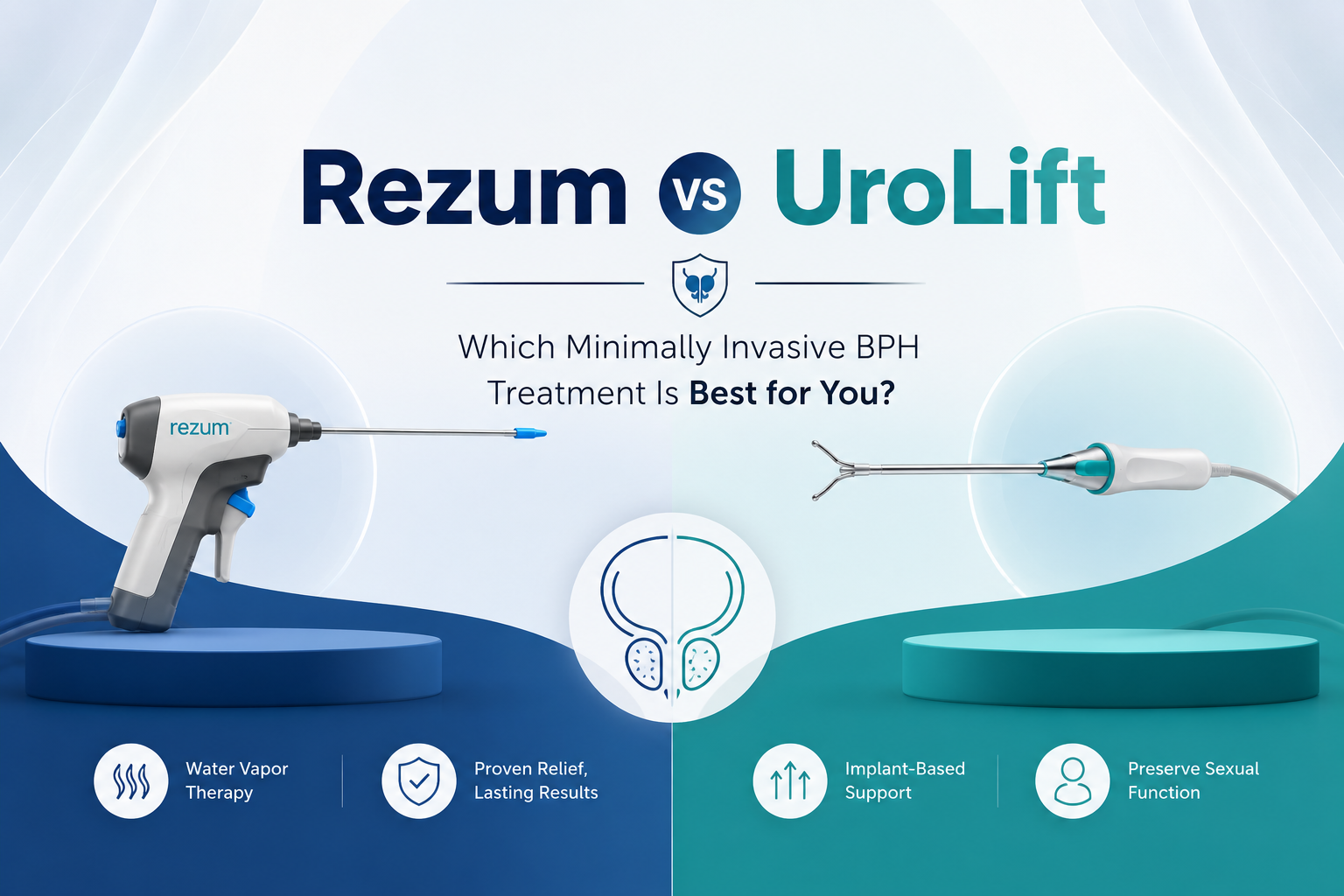
Rezum and UroLift are two leading minimally invasive treatments for BPH (benign prostatic hyperplasia), also called an enlarged prostate. UroLift uses small permanent implants to hold prostate tissue away from the urethra, allowing urine to flow freely. Rezum uses controlled steam (water vapor) injections to shrink prostate tissue over time.
Both are MIST (minimally invasive surgical therapy) options that offer faster recovery than traditional surgery like TURP or HoLEP. UroLift works faster with almost immediate symptom relief, while Rezum can treat a wider range of prostate sizes including the median lobe. UroLift carries a low risk of ejaculatory dysfunction, while Rezum may slightly impact sexual function in some men. Both procedures have strong 5-year durability data, though retreatment rates exist for both. The best choice between Rezum vs UroLift depends on prostate size, anatomy, sexual health priorities, and personal preferences. Always consult a board-certified urologist before deciding.
What Is BPH and Why Treatment Matters

If you wake up three times a night to use the bathroom… You already know something is wrong.
BPH, or benign prostatic hyperplasia, is a non-cancerous enlargement of the prostate gland. It is one of the most common conditions in men over 50. The enlarged prostate squeezes the urethra. That slows urine flow. It causes urgency, weak stream, incomplete emptying, and constant trips to the bathroom.
Left untreated, BPH can lead to urinary tract infections, bladder damage, and even kidney problems.
Medications like alpha-blockers and 5-alpha reductase inhibitors help many men. But for others, they stop working. Or the side effects become unbearable.
That is where MIST therapy for enlarged prostate comes in. Two of the most talked-about options today are Rezum and UroLift.
When Lifestyle Changes Are Not Enough
Most urologists recommend lifestyle changes first: cutting caffeine, reducing evening fluids, and bladder training. Medications come next.
But if symptoms are moderate to severe, or medications cause sexual side effects, minimally invasive procedures are often the next step. That is exactly where the Rezum vs UroLift conversation starts.
How Does UroLift Work?
UroLift is a simple office-based or outpatient procedure. It takes about an hour or less.
Here is what happens:
- A small device is inserted through the urethra.
- Tiny UroLift implants (think of them like permanent staples) are placed into the prostate tissue.
- These implants pull the prostate lobes apart. Like pulling curtains open on a window.
- The urethra opens up. Urine flows freely again.
No tissue is cut. No tissue is removed. The implants stay in permanently. Most men notice improvement within days.
UroLift Implants and the Prostate
The UroLift system was FDA-cleared in 2013. The implants are tiny (about the size of a staple). They are made of surgical-grade materials and are designed to stay in place for life.
Because no heat or energy is used, and tissue is not destroyed, ejaculatory function is typically preserved. This is a major reason many men and urologists choose UroLift, especially for sexually active men.
How Does Rezum Work?
Rezum is also a minimally invasive outpatient procedure. It takes about 10 to 15 minutes of treatment time.
Here is the process:
- A small device is inserted through the urethra.
- Controlled bursts of water vapor (steam) are injected directly into the enlarged prostate tissue.
- The steam transfers heat energy into the cells.
- Those cells die off gradually over the next 8 to 12 weeks.
- As the dead tissue is reabsorbed, the prostate shrinks. The urethra opens up.
Rezum Steam Injection and the Prostate
Rezum water vapor therapy was FDA-cleared in 2015. Unlike UroLift, it actually reduces the size of the prostate. This matters for men with larger prostates or a specific growth pattern called a median lobe.
Results build gradually. Most men see significant improvement within 3 months.
Rezum vs UroLift: Head-to-Head Comparison

Let us break this down clearly.
Procedure and Recovery Time
UroLift recovery time is faster. Men often return to normal life within 1 to 2 days.
Rezum recovery time is slightly longer, partly because a catheter after Rezum is often required for several days while swelling from the steam treatment subsides.
Side Effects
Both procedures carry minimal side effects compared to major surgery. But they are not identical.
UroLift side effects include:
- Temporary urinary urgency or burning (usually resolves in 2 to 4 weeks)
- Light blood in urine
- Mild pelvic discomfort
Rezum side effects include:
- Urinary burning and urgency (can last 4 to 6 weeks)
- Need for a temporary catheter
- Blood in urine or semen
- Mild pelvic discomfort
Neither procedure typically causes incontinence.
Sexual Function Preservation
This is often the deciding factor for many men.
UroLift and the risk of ejaculatory dysfunction is very low. Clinical data consistently show that UroLift does not cause retrograde ejaculation (when semen goes backward into the bladder instead of out). Most studies report that ejaculatory function is preserved in over 95% of men.
Rezum and sexual function preservation are reasonably good, but not as guaranteed. Some studies report that 4 to 10% of men may experience retrograde ejaculation after Rezum. This is still far better than TURP, which causes it in up to 90% of cases.
If preserving ejaculatory function is a top priority, UroLift has an edge.
Success Rates and Retreatment Rates
Both procedures work well. But neither is permanent for every man.
- UroLift success rates: About 80 to 85% of men report meaningful symptom improvement. The BPH retreatment rate for UroLift at 5 years is roughly 13 to 15%.
- Rezum success rates: About 83 to 88% of men report significant improvement. Retreatment rates at 5 years are around 11 to 12%.
Rezum edges ahead slightly on retreatment rates, likely because it physically reduces prostate tissue.
Durability and Long-Term Results
UroLift durability at 5 years shows sustained improvement in urinary symptom scores for most men. Long-term data is available from the L.I.F.T. trial.
Rezum's 5-year data (WATER trial) shows similar durability, with prostate tissue reduction that tends to hold over time.
Both are durable. Neither is a one-time-forever cure for everyone.
TURP vs UroLift vs Rezum (and Where HoLEP Fits In)

It is worth understanding the full landscape.
TURP (Transurethral Resection of the Prostate) is the traditional surgical gold standard. It is highly effective but requires general anesthesia, a hospital stay, and weeks of recovery. Retrograde ejaculation is almost guaranteed.
HoLEP (Holmium Laser Enucleation of the Prostate) is considered the best option for very large prostates. It has excellent long-term results but is a complex procedure requiring specialty expertise.
When comparing TURP vs UroLift vs Rezum, the minimally invasive options shine in recovery speed and sexual side effect profiles. But TURP and HoLEP are more complete solutions for advanced cases.
Think of it this way: UroLift and Rezum are like fixing a narrow hallway by rearranging furniture or removing some of it. TURP and HoLEP are like renovating the hallway entirely. More disruptive, but more thorough.
Who Is a Good Candidate for UroLift?
UroLift works best when:
- Prostate size is small to moderate (typically under 80 mL)
- There is no median lobe obstruction (an important anatomical consideration)
- The man wants a fast recovery and quick symptom relief
- Preserving ejaculatory function is a high priority
- The man does not want permanent implants (note: this is a paradox, as UroLift implants are permanent, which some men find reassuring, and others do not)
Who Is a Good Candidate for Rezum?
Rezum is a better fit when:
- Prostate size is moderate to large (up to 150 mL in some cases)
- A median lobe is present (Rezum can treat this; UroLift typically cannot)
- The man can tolerate a brief catheter period post-procedure
- Slightly slower improvement over 8 to 12 weeks is acceptable
- The goal is tissue reduction, not just mechanical opening
Which One Should You Choose?
Here is a practical framework:
Choose UroLift if:
- You want the fastest recovery
- Sexual function is a top concern
- Your prostate is smaller with no median lobe
Choose Rezum if:
- Your prostate is larger
- You have a median lobe
- You prefer tissue reduction over implants
And honestly: talk to your urologist. Not all urologists offer both. Some centers specialize in one over the other. Get a second opinion if needed. Ask specifically: "Am I a candidate for both? Why do you recommend one over the other for my anatomy?"
Conclusion
Choosing between Rezum vs UrolLift for BPH is not a one-size-fits-all decision.
UroLift is faster, has near-zero ejaculatory dysfunction risk, and suits smaller prostates. Rezum physically shrinks the prostate, handles larger sizes and median lobes, and has slightly better long-term retreatment data.
Both are excellent alternatives to TURP and HoLEP for the right patient. Both are far gentler on the body than traditional surgery.
Key takeaways:
- Ask your urologist about your prostate size and whether a median lobe is present.
- Prioritize sexual function? UroLift likely wins.
- Bigger prostate or median lobe? Rezum may be the better fit.
- Expect 5-year durability from both, but not permanent results for every man.
- Never make this decision based on the internet alone. Use this article to ask better questions at your next appointment.
Looking for a Specialist Who Performs Both Rezum and UroLift?
Not every urologist offers both procedures. That alone can bias a recommendation.
Dr. Ashish Saini at Excel Advanced Urology Center, New Delhi, is trained and experienced in both Rezum and UroLift, along with HoLEP, iTind, and TURP. With an M.Ch in Urology from AIIMS New Delhi, 15+ years of experience, and over 21,000 surgeries performed, he is one of the most trusted names in BPH treatment in India.
He evaluates your prostate anatomy first, then recommends the right procedure for you, not just the one he is most comfortable with.