
}})
You wake up three times a night. Every road trip means mapping out every rest stop. You stand at the urinal for what feels like forever. And still, the stream is weak.
Sound familiar?
If you are a man over 50, there is a real chance your prostate is the problem. Benign prostatic hyperplasia, or BPH, affects millions of men worldwide. It is not cancer. But it can quietly take over your quality of life.
The good news? You do not have to choose between a lifetime of daily medication and invasive surgery. The UroLift procedure is a non-surgical, office-based treatment that many men are now choosing instead. It works. It is fast. And it does not harm your sexual function.
This article walks you through everything you need to know, including how UroLift works, what the procedure feels like, how it compares to TURP and BPH drugs, who qualifies, and what the real risks are.
Key Takeaways Before You Read
- The UroLift procedure is a minimally invasive, non-surgical treatment for an enlarged prostate (BPH).
- It uses tiny UroLift implants to physically lift prostate tissue away from the urethra, restoring normal urine flow.
- There is no cutting, no heating, and no tissue removal involved.
- The procedure typically takes less than 30 minutes and is performed in an office or outpatient setting.
- UroLift uses local anesthesia, so most patients go home the same day.
- Clinical data show UroLift preserves sexual function, with extremely low rates of erectile dysfunction or retrograde ejaculation.
- Most men can return to normal activities within a few days, making recovery far faster than traditional surgery.
- UroLift outperforms BPH medication in symptom relief and helps many men get off BPH medications entirely.
- The UroLift system is FDA-approved and has over five years of consistent clinical data supporting its results.
- Ideal candidates are men 45 years or older with a small-to-moderate-sized prostate who want to avoid surgery or stop taking daily medication.
What is an Enlarged Prostate and Why Does It Matter?
Think of the prostate as a donut wrapped around a straw. The straw is your urethra, the tube that carries urine out of your body. When the prostate grows, it squeezes that straw tighter and tighter.
That is BPH. It is not cancer. It is just your prostate getting bigger with age. And it is extremely common. Over half of men in their 60s have BPH symptoms, and that number climbs above 80% by age 80.
The symptoms are frustrating:
- Weak or slow urine stream
- Frequent bathroom trips, especially at night
- Difficulty starting urination
- Feeling like the bladder never fully empties
- Urgency that hits without warning
For years, the standard answer was either medication or surgery. Both have trade-offs. The UroLift non-surgical prostate treatment is now changing what men can expect.
What Is the UroLift Procedure?
The UroLift System Explained Simply
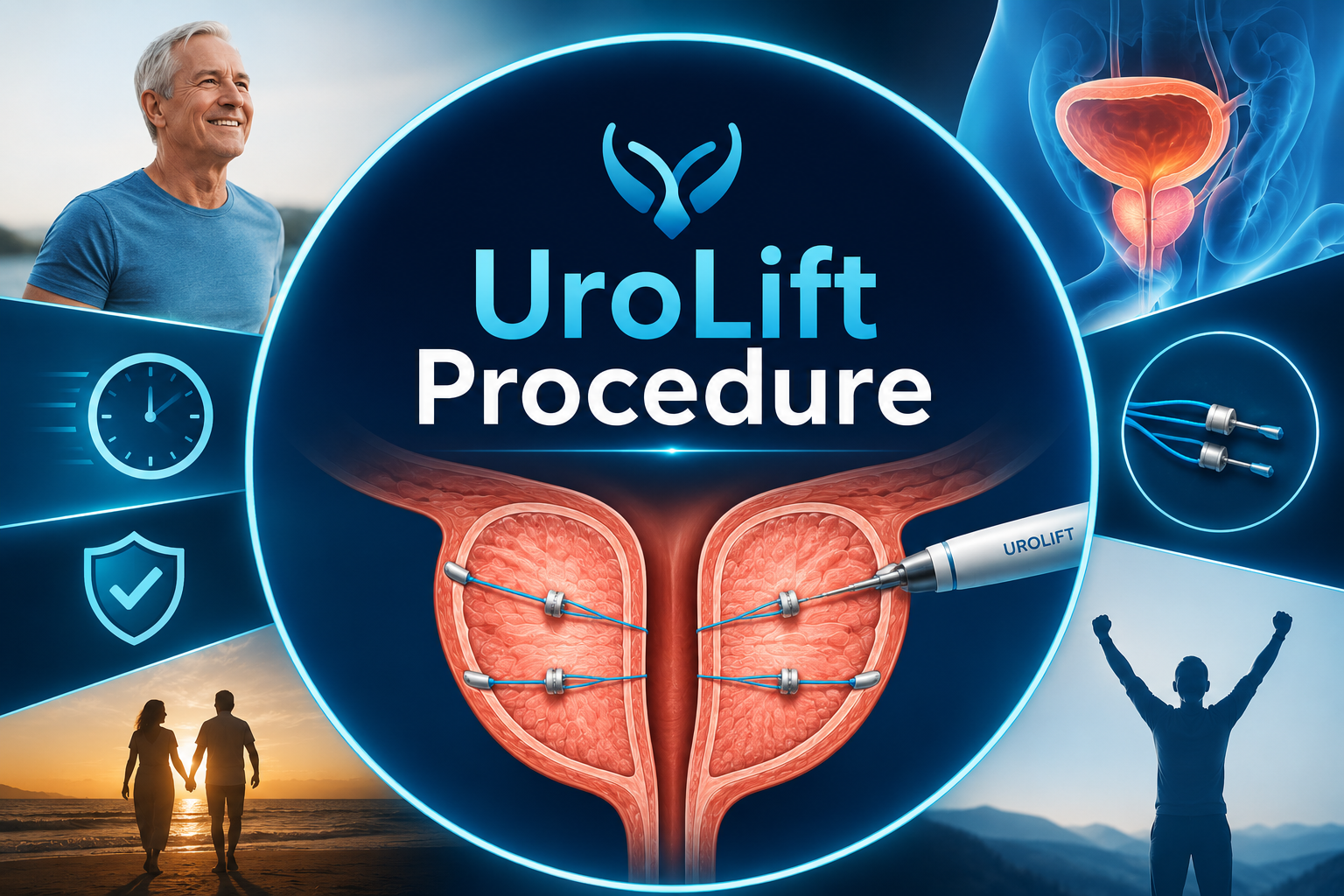
The UroLift system is a small medical device that uses permanent implants to physically hold enlarged prostate tissue out of the way. Picture a curtain being pulled back from a window. Once the tissue is moved aside, the urethra opens up and urine flows freely again.
Is it that straightforward?
The procedure was developed to give men a real option between taking pills forever and going under the knife. UroLift was approved by the FDA in 2013 and has been used by thousands of urologists worldwide since then.
No Cutting. No Heating. No Tissue Removal.
This is the part that surprises most men the first time they hear it.
Traditional surgery (TURP) shaves or burns away prostate tissue. Medications try to shrink the prostate chemically. UroLift does neither.
Instead, the UroLift implants act like small anchors. They grab the enlarged prostate tissue and hold it back. No tissue is destroyed. No incisions are made. The prostate is simply repositioned.
This is why the recovery is so fast and why sexual function is preserved.
How Does UroLift Work? (Step-by-Step)
Here is exactly what happens during the UroLift procedure from start to finish.
Step 1 – Preparation and Local Anesthesia
The procedure is done in the doctor's office or an outpatient surgery center. You do not need general anesthesia. Most patients receive local anesthesia along with mild sedation to stay comfortable.
This is a big deal. It means no breathing tube. No long pre-op fasting. Less risk. And you are awake enough to walk out shortly after.
Step 2 – Cystoscopy and Visualizing the Prostate
The urologist uses a UroLift cystoscopy technique. A thin scope is inserted through the urethra. This lets the doctor see exactly where the prostate tissue is blocking the flow of urine.
Think of it like a plumber using a camera to find a pipe blockage before fixing it.
Step 3 – Placing the UroLift Implants
Once the blockage is identified, the delivery device places small implants through the scope. Each UroLift implant is made from nickel-titanium (nitinol) and a small polyethylene terephthalate suture. The implants grab the prostate tissue on one side and anchor to the other side of the urethra wall.
With each implant placed, the channel opens up wider. On average, about 4 to 5 implants are placed per procedure.
The entire placement process takes under 30 minutes for most patients.
Step 4 – Recovery and Going Home
Once the implants are in, the scope is removed. Most men go home the same day. In the majority of cases, no catheter is needed after the procedure.
You might feel some mild burning or urgency for the first few days. That is completely normal. It settles down quickly.
UroLift vs Surgery (TURP): What Is the Real Difference?
This is one of the biggest questions men ask when researching BPH options. Let us look at it head-on.
TURP (transurethral resection of the prostate) has long been the gold standard surgical treatment for BPH. It works well. But it comes at a cost.
UroLift vs TURP comes down to priorities. If you need aggressive symptom relief and have a very large prostate, TURP may deliver stronger results. But if you value a fast recovery, preserved sexual function, and avoiding surgery, UroLift has a clear advantage for the right candidate.
As one Cleveland Clinic urologist put it: "This is a quality-of-life issue that requires shared decision-making."
UroLift vs BPH Medications: Which Is Better?
Most men with BPH start on medication. Alpha-blockers like tamsulosin (Flomax) relax muscle tissue in the prostate. 5-alpha reductase inhibitors try to shrink it. They can help. But they come with their own problems.
Common issues with BPH medications:
- Daily commitment. Miss doses and symptoms return fast.
- Side effects. Dizziness, fatigue, low blood pressure, and sexual dysfunction are all reported.
- Ejaculatory problems. Alpha-blockers can cause retrograde ejaculation, too, with one-year adherence rates as low as 29% because of side effects.
- They do not fix the problem. Medications manage symptoms but do not address the mechanical blockage.
The IMPACT trial, one of the first randomized controlled trials comparing UroLift directly against BPH medication, showed that patients treated with UroLift met their treatment outcome expectations better than those on medication.
UroLift vs medication BPH is not even a close comparison for men who want a long-term solution. Clinical studies show that most men who have the UroLift procedure can get off BPH medications entirely.
Does UroLift Preserve Sexual Function?
Yes. And this is arguably the most important reason men choose UroLift over other BPH treatments.
Here is the honest picture:
- Erectile dysfunction (ED): The risk of new ED after UroLift is extremely low. Long-term data over five years shows that erectile function is preserved. Some men actually report improved sexual confidence because their urinary symptoms are gone.
- Retrograde ejaculation (dry orgasm): This is where UroLift truly stands out. With TURP, retrograde ejaculation affects 38% to 89% of patients. With UroLift, clinical studies consistently show the rate is effectively zero for de novo (new) ejaculatory dysfunction.
- Libido and sensation: No negative changes reported in clinical trials.
Why does UroLift preserve function so well? Because it does not use heat, does not cut tissue, and does not disrupt the nerves and structures responsible for ejaculation and erection.
UroLift preserves sexual function in a way that medications and surgery simply cannot match. For younger men or men who are sexually active, this is often the deciding factor.
UroLift Side Effects and Risks You Should Know
UroLift is safe. But it is not without side effects. You deserve the full picture.
Common and temporary side effects (usually resolve within 2 to 4 weeks):
- Dysuria – burning or discomfort during urination
- Urinary urgency and frequency – needing to go more often right after the procedure
- Blood in urine (hematuria) – typically light and short-lived
- Mild pelvic discomfort
Less common risks:
- Urinary tract infection (UTI) – possible, as with any procedure involving the urethra
- Temporary urinary retention – rarely, a short-term catheter may be needed
- Implant-related concerns – UroLift implants contain nickel-titanium (nitinol). Men with a known nickel-titanium allergy should discuss this with their urologist before proceeding.
What UroLift does NOT cause (unlike TURP and medications):
- Retrograde ejaculation
- Erectile dysfunction
- Urinary incontinence (permanent)
One important note: UroLift does not stop the prostate from growing. Your prostate may continue to enlarge over time. If symptoms return years later, the procedure can be repeated, or another treatment can be used.
Who Is a Good Candidate for UroLift?
Not every man with BPH is the right fit. Here is how to know if UroLift might be right for you.
You may be a good candidate if:
- You are 45 years or older (the FDA-approved age requirement for the UroLift system)
- Your prostate is small to moderate in size (generally under 80cc or 80mL in volume)
- You have moderate to severe BPH symptoms that affect your daily life
- You want to avoid surgery or stop taking daily BPH medication
- You want to preserve ejaculatory and erectile function
- You prefer a quick recovery and getting back to normal life fast
UroLift may NOT be right if:
- Your prostate is very large (over 80cc)
- You have a median lobe obstruction (though newer UroLift versions can address some median lobe cases)
- You have active urinary tract infections or prostate cancer
- You have a known allergy to nickel-titanium
- You are unwilling to accept that the procedure may not fully resolve symptoms
Am I a candidate for UroLift?
The only real answer comes from your urologist after a prostate assessment, including prostate volume measurement and possibly a cystoscopy. If you are tired of daily pills or want to avoid the risks of TURP, it is worth bringing up.
Recovery After UroLift: What to Expect
One of the biggest selling points of UroLift is the rapid recovery and return to normal activities.
Here is a general timeline:
- Day 1: Go home the same day. Rest. Drink plenty of water. Mild discomfort is normal.
- Days 2 to 5: Most men feel well enough to resume light daily activities. Burning and urgency usually start to improve.
- Week 1 to 2: Urinary symptoms often improve noticeably. Most men see a significant improvement in urine flow.
- Week 4 to 6: Full symptom improvement is typically reached. This is also when sexual function concerns (if any) should resolve.
Compare this to TURP surgery, which can require 4 to 6 weeks of recovery before returning to normal activity.
A few practical recovery tips:
- Avoid heavy lifting and strenuous exercise for the first 1 to 2 weeks
- Stay well hydrated to help flush the urinary tract
- Report any fever, worsening pain, or inability to urinate to your doctor immediately
- Follow your urologist's post-procedure instructions carefully
Conclusion: Ready to Stop Living Around a Bathroom?
BPH does not have to run your life.
The UroLift procedure gives you a real way out. No surgery, no cutting, no lengthy recovery. Just a short office procedure that restores urine flow and protects your sexual function. Most men go home the same day.
If you are in Delhi NCR, Dr. Ashish Saini is the right person to talk to. Trained at AIIMS New Delhi, with over 15 years of experience and 21,000+ urology surgeries performed, he offers advanced, minimally invasive prostate treatments including UroLift at Excel Advanced Urology Center, Greater Kailash 1.