
}})
You finally see your urologist. You have been waking up four times a night. Your urine stream is a trickle. And your daily BPH medication is causing more problems than it is solving.
He mentions two options: Rezum and UroLift.
You nod. But inside, you are thinking, "What on earth is the difference? Which one actually works? And will it hurt?"
You are not alone. Millions of men with benign prostatic hyperplasia (BPH) face this exact moment every year. This article breaks it all down in plain, simple language. You will learn how the Rezum procedure works, what the real success rate looks like, which side effects to expect, how long recovery takes, and how it stacks up against the UroLift procedure.
Let us get into it.
Key Takeaways Before You Read
- Rezum water vapor therapy uses steam to destroy excess prostate tissue and relieve BPH symptoms without surgery.
- The Rezum success rate is strong. Clinical data show symptom scores improve by 50% or more, with results lasting up to 5 years.
- Most men experience full symptom relief within 3 months after the procedure.
- Rezum side effects include temporary urinary burning, urgency, and blood in the urine. These typically resolve within 2 to 4 weeks.
- A catheter is usually needed for about 3 days after the Rezum procedure while the prostate heals.
- The procedure is done under local or mild sedation and takes about 30 minutes or less.
- Rezum vs UroLift: Rezum destroys tissue using steam. UroLift lifts and holds tissue without destroying it.
- Rezum cost without insurance ranges from approximately $3,000 to $5,000. UroLift cost without insurance ranges from $4,000 to $6,000.
- Medicare covers both Rezum and UroLift when medical necessity criteria are met.
- Good candidates for Rezum include men with moderate to large prostates, while UroLift is preferred for smaller prostates in men who want zero ejaculatory risk.
What Is Rezum Water Vapor Therapy?
Think of your prostate like a sponge squeezed around a straw. The straw is your urethra. When the sponge swells, it chokes the straw. That is BPH.
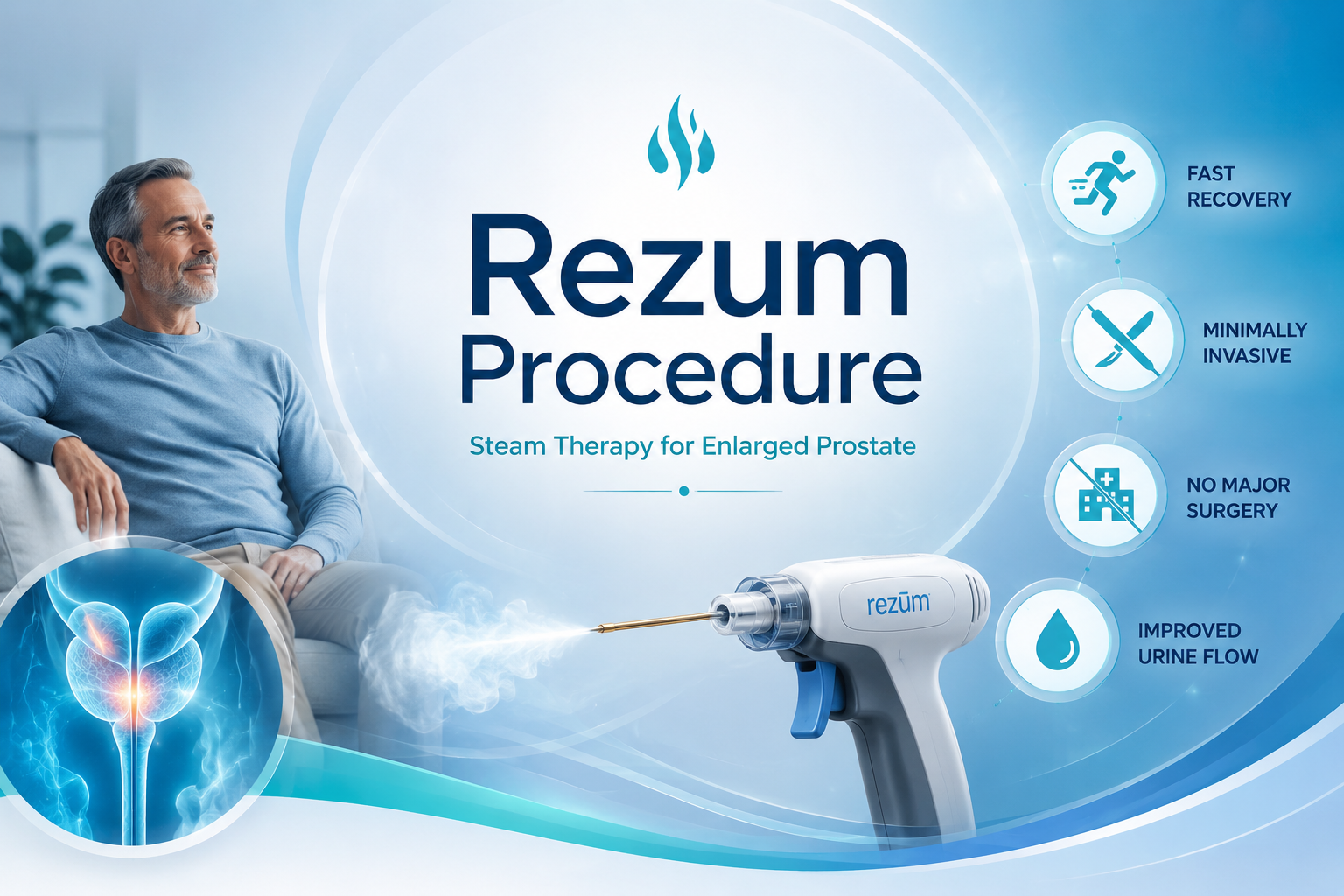
Rezum water vapor therapy uses the natural energy stored in steam to shrink and destroy the excess prostate tissue that is causing the blockage. The steam does the work. No scalpels. No lasers. No implants.
The procedure was developed by Boston Scientific and received FDA approval in 2015. Since then, it has been used widely across urology practices as a minimally invasive alternative to traditional surgery.
The key advantage? The tissue does not just get pushed aside like with UroLift. It actually dies off and is reabsorbed by the body over time. This means the results tend to be long-lasting, and the prostate shrinks in volume.
How Does Rezum Work? (Step-by-Step)

Here is exactly what happens during the procedure.
Step 1: Preparation
You arrive at the clinic or outpatient surgery center. Most patients receive local anesthesia with or without mild sedation. General anesthesia is not required in most cases.
Step 2: Insertion of the Device
The urologist inserts a small handheld device through the urethra. No incisions are made. The device is guided directly to the area of prostate tissue causing the blockage.
Step 3: Steam Injections
Here is the key part. The device delivers controlled bursts of water vapor (steam) directly into the prostate tissue. Each injection lasts just 9 seconds. The steam releases stored energy into the tissue. The tissue cells are destroyed.
The number of injections depends on the size of the prostate. Larger prostates need more injections. The whole process usually takes less than 30 minutes.
Step 4: Catheter Placement and Going Home
After the procedure, a temporary catheter is placed to support healing. Most men go home the same day. The catheter is typically removed within 3 to 5 days at a follow-up visit.
Rezum Success Rate: What the Numbers Say
This is where Rezum really earns its credibility.
Multiple clinical studies confirm strong outcomes:
- Symptom scores (IPSS) improve by 50% or more in most patients, based on real-world data from over 211 patients followed for up to 4.5 years.
- Urine flow rate improves by up to 66% compared to baseline.
- Retreatment rates are low. A 2025 multicenter study found Rezum's 5-year retreatment rate was approximately 6.8%, which is lower than UroLift's 5-year rate of 10.8%.
- 5-year durability is confirmed in the landmark randomized controlled trial published in the Journal of Urology.
How long until Rezum results appear? Most men notice initial improvement within 2 weeks. Full results typically develop over 3 months as the destroyed tissue is reabsorbed by the body.
That timeline is longer than UroLift. But the depth of symptom relief is often greater for men with larger prostates.
Rezum Side Effects: The Honest Picture

No procedure is without trade-offs. Rezum is safe, but you deserve the full picture.
Common side effects (usually temporary, resolving within 2 to 4 weeks):
- Burning or discomfort when urinating (dysuria)
- Urinary urgency and increased frequency
- Blood in the urine (hematuria) or semen
- Feeling like the bladder is not fully emptying
- Mild pelvic or penile discomfort
Less common but possible:
- Urinary tract infection (UTI)
- Temporary urinary retention (needing a catheter beyond the initial few days)
- Decreased ejaculatory volume in some men
Rare risks:
- Narrowing of the bladder neck
- Bladder stone
- Severe infection
- Worsening erectile dysfunction (rare, and typically pre-existing)
One important note on sexual function: Rezum has a much lower rate of retrograde ejaculation than TURP surgery. However, some studies report ejaculatory dysfunction rates of 3% to 6% with Rezum. Compare that to 38% to 89% with TURP. It is far safer for sexual function. But UroLift, which does not destroy tissue at all, shows effectively zero rates of new ejaculatory dysfunction. If preserving ejaculation is your top priority, this distinction matters.
How Painful Is the Rezum Procedure?
This is the question men ask most often before booking.
Most patients describe the procedure as uncomfortable rather than painful. The local anesthesia handles the bulk of it. During each steam injection, you may feel a brief sensation of heat or pressure. It passes in seconds.
Think of it like a pinch that lasts nine seconds. Then it is done. Then another. Most men tolerate it well.
After the procedure, the first few days can bring burning and urgency during urination. This is the tissue responding to the steam treatment. It is temporary. Most men manage it with over-the-counter pain relief and increased hydration.
By the end of week two, the worst of the discomfort has usually passed.
What to Expect After the Rezum Procedure

Recovery from Rezum is manageable but requires some patience, especially compared to UroLift.
Here is a realistic timeline:
- Day 1 to 3: Catheter in place. Rest at home. Mild burning and urgency are normal.
- Day 3 to 5: Catheter removed at follow-up visit. Some men experience continued urgency and frequency.
- Week 1 to 2: Discomfort begins to ease. Initial improvement in urine flow may appear.
- Week 4 to 6: Significant symptom improvement for most men.
- Month 3: Full results are typically reached as treated tissue is reabsorbed.
Practical tips during recovery:
- Drink plenty of water to flush the urinary tract
- Avoid strenuous exercise and heavy lifting for 1 to 2 weeks
- Report any fever, severe pain, or inability to urinate immediately to your doctor
- Take any prescribed medications as directed
Rezum vs UroLift: A Head-to-Head Comparison
Both procedures treat BPH without traditional surgery. But they work in very different ways.
How Does UroLift Work?
The UroLift procedure places tiny permanent implants through the urethra to physically lift and hold the enlarged prostate tissue out of the way. No tissue is cut, heated, or removed. It is purely mechanical. Think of it like pulling a curtain back to let light in.
Because no tissue is destroyed, the results appear faster. Most men notice improvement within days to weeks of UroLift.
UroLift Side Effects vs Rezum Side Effects
Rezum Recovery Time vs UroLift Recovery Time
- Rezum recovery time: Most men return to normal activities within a few days, but full symptom improvement takes up to 3 months.
- UroLift recovery time: Most men return to normal activities within a few days, with noticeable improvement often within 1 to 2 weeks.
UroLift wins on speed of recovery. Rezum wins on long-term durability for larger prostates.
UroLift vs Rezum: Which Is Better?
Neither treatment is universally better. It comes down to your specific situation.
Rezum tends to be better if:
- Your prostate is moderately large to large (up to 80cc or more)
- You have a median lobe of the prostate contributing to obstruction
- You are okay with a slightly longer recovery in exchange for stronger tissue reduction
UroLift tends to be better if:
- Your prostate is small to moderate in size
- You want zero risk of ejaculatory dysfunction
- You want the fastest possible recovery
- You want to avoid any catheter after the procedure
A 2024 study comparing patient-reported outcomes found that Rezum-treated patients showed greater overall symptom improvement in AUA symptom scores (9.83 post-treatment) compared to UroLift-treated patients (13.37 post-treatment), with a lower score meaning better outcomes.
Rezum Cost Without Insurance and Medicare Coverage
Does Medicare Cover Rezum?
Yes. Medicare does cover Rezum when specific medical necessity criteria are met. According to Medicare's 2024 pricing data:
- In an ambulatory surgical center: average out-of-pocket cost of approximately $356
- In a hospital outpatient department: average out-of-pocket cost of approximately $739
These are what patients pay after Medicare covers its share. The full procedure cost without Medicare is significantly higher.
Does Medicare Cover UroLift?
Yes. Medicare also covers UroLift under Medicare Part B when it is deemed medically necessary by your healthcare provider and performed as an outpatient procedure.
UroLift Cost Without Insurance
Without insurance, the UroLift procedure costs typically range between $4,000 and $6,000. This varies based on location, facility type, and number of implants used.
Rezum cost without insurance is generally slightly lower, ranging from approximately $3,000 to $5,000, though costs vary widely.
Always speak with your urologist's billing team and your insurance provider to get an accurate estimate before scheduling.
Conclusion: Your Prostate Problem Has a Modern Solution
Living with BPH is exhausting. The broken sleep. The urgency. The bathroom planning. None of it is something you should simply accept.
Rezum water vapor therapy offers a genuine, clinically proven path out. A 30-minute procedure. No surgery. No major incisions. And symptom relief that holds up for five years or more.
UroLift is equally compelling for the right patient. Faster visible results, zero catheter in most cases, and the gold standard for preserving ejaculatory function.
The truth? Both work. Both are safe. The best one is whichever fits your prostate, your lifestyle, and your priorities.
Talk to a specialist. Get your prostate size measured. Ask which procedure matches your anatomy. That single conversation could change the way you sleep tonight.