
}})
Urethral stricture is a condition that can slowly affect everyday life. At first, it may just feel like a slightly weak urine stream. Over time, it can turn into straining, incomplete emptying, repeated infections, and even sudden urinary blockage. Many men search for a solution that is effective but not too invasive. That is where laser treatment for urethral stricture, also known as holmium laser urethrotomy, becomes an option.
But is laser treatment truly effective? Does it cure the problem permanently? Or is it temporary relief? Let us understand this clearly in simple language.
What Is Urethral Stricture?
The urethra is the tube that carries urine from the bladder out of the body. When scar tissue forms inside this tube, it narrows the passage. This narrowing is called a urethral stricture.
You can imagine it like a garden pipe. If mud builds up inside, water does not flow freely. The pressure increases. The flow becomes weak. The same happens with urine.
Scar tissue may develop due to infection, injury, previous catheter use, prostate procedures, or sometimes without a clear cause. The narrowing may be short and mild. In some cases, it can be long and severe.
Common symptoms include a weak stream, spraying urine, straining to pass urine, frequent urinary infections, and feeling that the bladder is not fully empty. In severe cases, complete blockage can occur. That becomes a medical emergency.
What Is Laser Treatment for Urethral Stricture?
Laser treatment for urethral stricture is a minimally invasive endoscopic procedure. It is commonly called holmium laser urethrotomy.
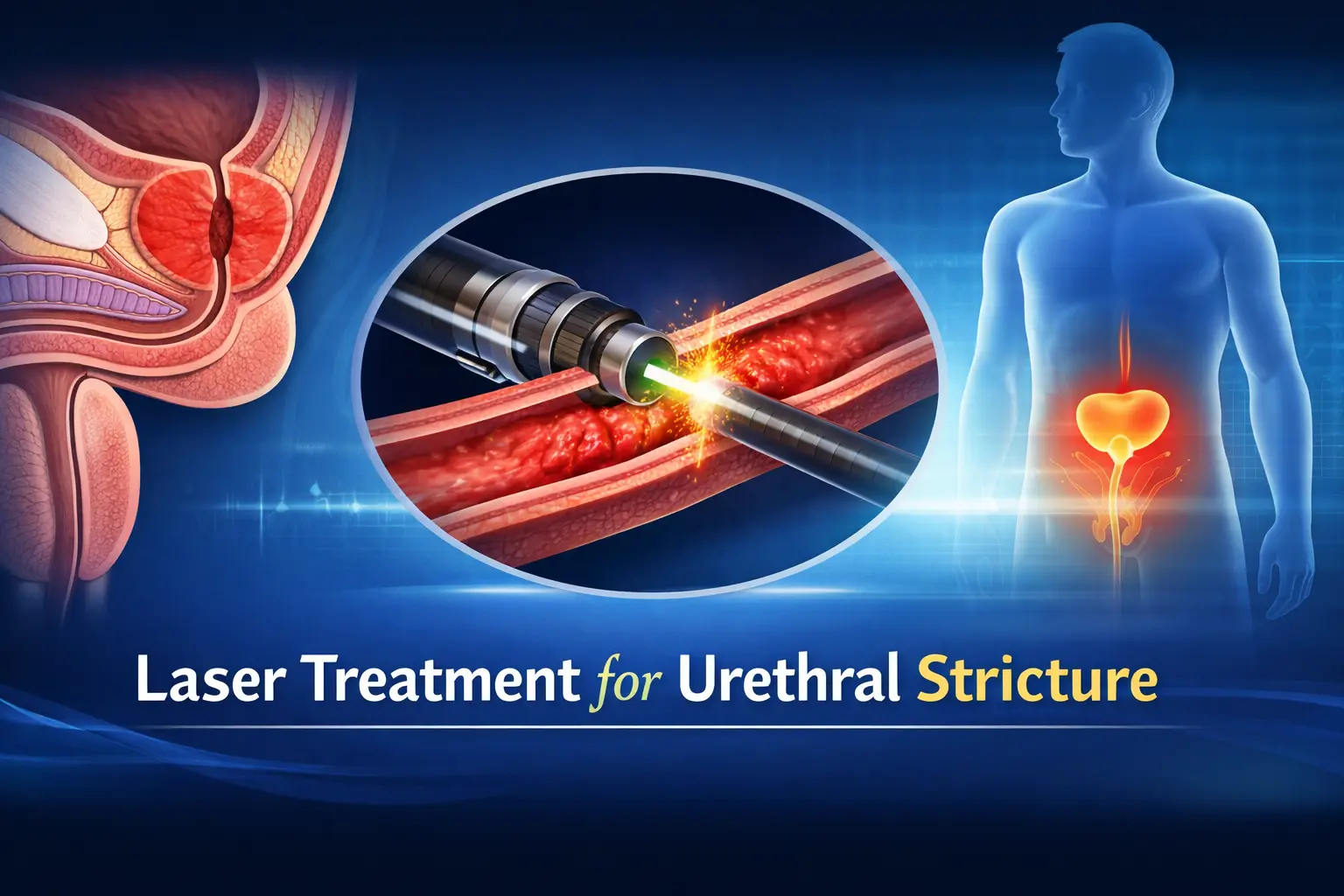
Instead of making an external incision, the surgeon inserts a thin camera through the natural urinary passage. Once the narrowed segment is identified, a holmium laser is used to carefully cut the scar tissue. This widens the channel and improves urine flow.
There are no external stitches. There is no large surgical wound. The procedure is performed through the urethra itself.
Think of it like carefully opening a tight ring inside a tunnel so that traffic can move freely again.
How Laser Urethrotomy Works
The process begins with proper evaluation. Doctors usually perform tests such as uroflowmetry to measure urine flow, ultrasound to check bladder emptying, and cystoscopy to directly visualize the narrowing. These steps are important. They help confirm the length, location, and severity of the stricture.
On the day of the procedure, spinal anesthesia or short general anesthesia is given. The patient does not feel pain during the surgery. A small endoscope is gently passed through the urethra until the narrowed segment is reached. The holmium laser is then used to make a controlled incision in the scar tissue.
Laser energy allows precise cutting with minimal bleeding. After widening the narrowed area, a catheter is placed inside the urethra. This catheter keeps the passage open while healing occurs. It usually remains for a few days.
The entire procedure is often completed within 30 to 60 minutes.
Which Urethral Strictures Are Suitable for Laser Treatment?
Laser urethrotomy works best in selected patients. It is most effective in short segment strictures, especially those located in the bulbar urethra. It is also more successful when it is the first treatment for that stricture.
However, not every stricture responds well to laser treatment. Long strictures, dense scar tissue, or strictures that have already failed multiple treatments are less likely to have durable results with laser alone.
This is important to understand. Laser is not a universal cure. Proper patient selection plays a major role in long-term success.
Is Laser Treatment Better Than Dilation?
Urethral dilation and laser urethrotomy are different approaches.
Dilation stretches the narrowed area. It does not cut the scar. It provides temporary relief, but the scar often tightens again. Repeated dilation may even worsen scarring over time.
Laser urethrotomy, on the other hand, cuts the scar tissue. It directly opens the narrowing. It offers more precision and less bleeding compared to older cold-knife techniques.
While laser is more advanced than simple dilation, recurrence can still occur. The underlying tendency of scar tissue to reform remains.
Success Rate of Laser Urethrotomy
The success rate of laser urethrotomy depends largely on the type of stricture.
For short bulbar strictures treated for the first time, success rates are reasonably good. Many patients experience significant improvement in urine flow and symptom relief.
However, the success rate decreases if the stricture is long or has recurred after previous procedures. Repeat laser treatments generally have lower long-term success compared to the first procedure.
It is important to be realistic. Urethral stricture disease has a known recurrence pattern. Even after successful laser treatment, narrowing can return months or years later.
Long-Term Effectiveness and Recurrence
Patients often ask, “Is laser treatment permanent?”
In some cases, yes. In others, no.
For carefully selected short strictures, laser urethrotomy can provide long-term relief. But recurrence is not uncommon. Studies show that the risk of recurrence increases with longer strictures and previous failed treatments.
Doctors usually recommend regular follow-up after laser treatment. This may include urine flow testing and occasional endoscopic evaluation. In selected patients, self-calibration with a small catheter may be advised to reduce recurrence.
Early detection of recurrence allows timely intervention before symptoms worsen.
When Is Laser Urethrotomy Recommended?
Laser urethrotomy is typically recommended when the stricture is short and it is the first episode. It is also considered when patients prefer a minimally invasive approach or are not suitable for open surgery.
It provides quicker recovery and minimal hospital stay. For many men, this is an attractive option.
However, when strictures are long, recurrent, or associated with dense fibrosis, open reconstructive surgery called urethroplasty often provides better long-term outcomes.
Recovery After Laser Treatment
One of the main advantages of laser urethrotomy is faster recovery compared to open surgery.
Most patients stay in the hospital for a day or sometimes go home the same day. The urinary catheter remains for three to seven days. After removal, mild burning during urination may occur temporarily.
Most patients can return to routine activities within one to two weeks. Heavy lifting and strenuous activity are usually avoided for a short period.
Many men notice immediate improvement in urine flow once the catheter is removed. That relief can feel dramatic, especially if symptoms were severe before treatment.
Risks and Complications
Laser urethrotomy is generally safe when performed by experienced surgeons. Still, like any medical procedure, it carries some risks.
Possible complications include mild bleeding, urinary infection, temporary discomfort, and recurrence of the stricture. Serious complications are uncommon.
The most important long-term concern is recurrence. That is why follow-up is essential.
Quality of Life After Laser Treatment
For many patients, the improvement in quality of life is significant. A stronger urine stream means less straining. Better bladder emptying reduces infection risk. Nighttime urination may decrease. Sleep improves.
Relief from urinary symptoms often improves confidence and daily comfort.
However, understanding that recurrence is possible helps patients stay alert and maintain follow-up care.
Laser Treatment vs Urethroplasty
Laser urethrotomy is minimally invasive and suitable for short strictures. Urethroplasty is open reconstructive surgery that removes the scar tissue completely and rebuilds the urethra.
Urethroplasty has higher long-term success rates, especially for long or recurrent strictures. But it involves longer recovery and more extensive surgery.
Choosing between the two depends on stricture length, prior treatments, patient age, overall health, and personal preference. A urologist evaluates all these factors before recommending the best approach.
Conclusion
Laser treatment for urethral stricture is an effective and minimally invasive option for selected patients. It works best for short, first-time strictures and offers faster recovery with minimal bleeding.
However, it is not a guaranteed permanent cure for every case. Recurrence remains possible, particularly in longer or recurrent strictures. Careful evaluation and regular follow-up determine long-term success.
If you notice weak urine flow, straining, or recurrent urinary infections, do not ignore the symptoms. Early consultation with a qualified urologist allows timely diagnosis and appropriate treatment selection.
The right treatment at the right time makes all the difference in protecting long-term urinary health.