
}})
Many men struggle with urinary symptoms such as weak urine flow, straining, or frequent trips to the bathroom. Sometimes the problem is not the prostate. Instead, the issue lies at the bladder neck, which is the opening where the bladder connects to the urethra.
In some men, this opening does not relax or open properly during urination. This condition is known as a high bladder neck or bladder neck obstruction. It can cause significant difficulty passing urine, even when the prostate is small.
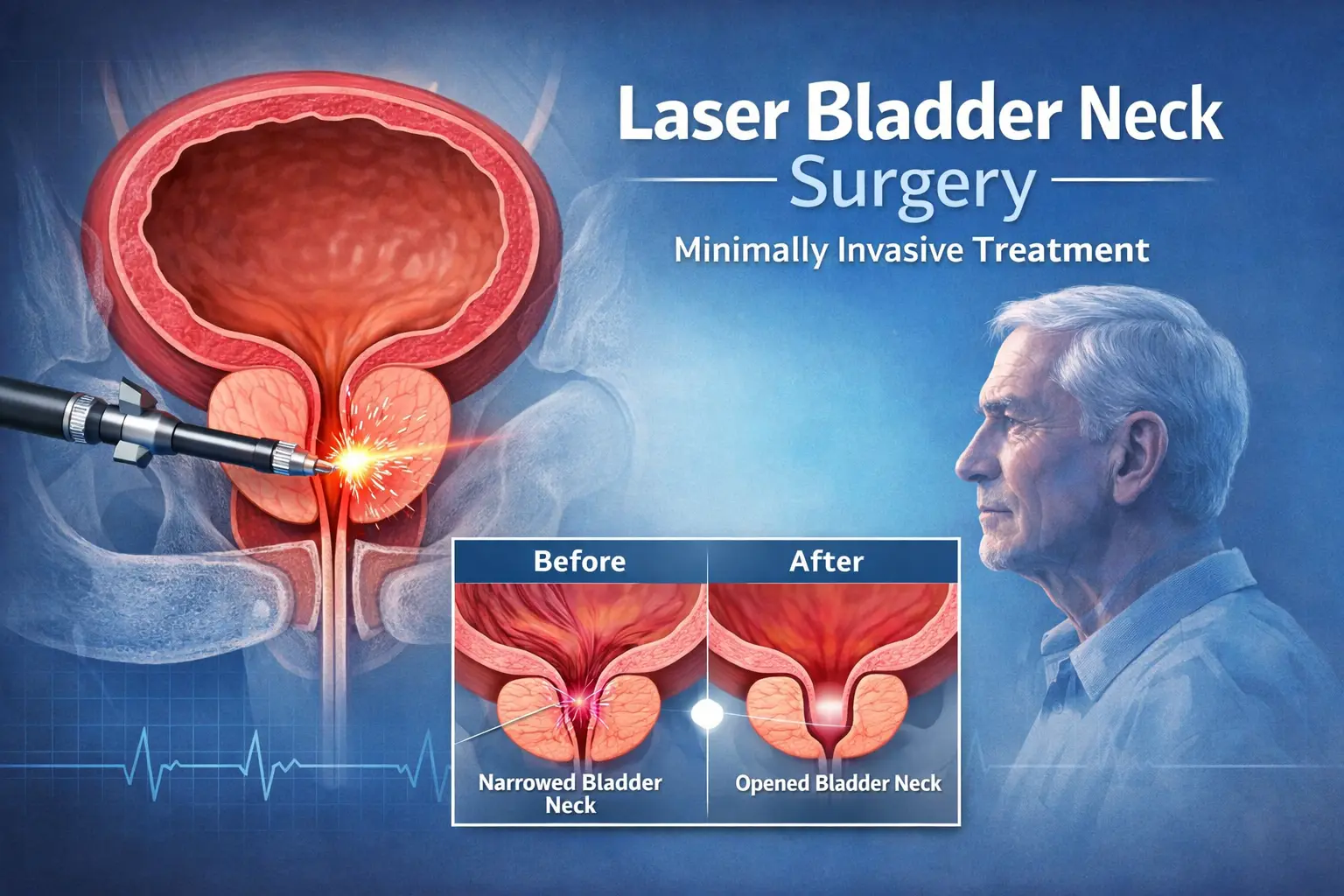
Modern urology now offers laser surgery for high bladder neck, also called holmium laser bladder neck incision (HoLBNI). This minimally invasive procedure helps open the tight bladder outlet and improve urine flow.
Let us understand the condition, the procedure, and what patients can expect before and after surgery.
What Is High Bladder Neck?
The bladder neck is the circular opening at the bottom of the bladder. It acts like a valve that controls urine flow into the urethra.
Normally, this valve relaxes when you urinate. The bladder muscle contracts, the neck opens, and urine flows out smoothly.
In some men, the bladder neck remains tight or elevated. It does not open completely during urination. This creates a functional obstruction, even when the prostate gland is not enlarged.
Imagine trying to pour water through a bottle that has a narrow cap opening. The water may still come out, but slowly and with effort. That is similar to what happens with a high bladder neck.
Common Symptoms
Men with high bladder neck obstruction may experience:
- Weak urine stream
- Straining while urinating
- Feeling of incomplete bladder emptying
- Frequent urination
- Night-time urination
- Intermittent urine flow
These symptoms often resemble those caused by prostate enlargement. That is why proper evaluation is essential.
What Is Laser Bladder Neck Incision (BNI)?
Laser bladder neck incision is a minimally invasive endoscopic procedure used to treat bladder outlet obstruction caused by a high bladder neck.
The procedure is commonly called holmium laser bladder neck incision (HoLBNI).
Instead of removing tissue like prostate surgery, the surgeon makes a small incision in the bladder neck. This releases the tight ring of muscle that is blocking urine flow.
The incision is made using a holmium laser delivered through an endoscope. Because the procedure is performed through the urethra, there are no external cuts or stitches.
The goal is simple: open the bladder outlet so urine can flow freely again.
How Laser Bladder Neck Incision Works
Understanding the procedure step by step helps patients feel more comfortable and informed.
Preoperative Evaluation
Before surgery, doctors perform tests to confirm the diagnosis. These may include uroflowmetry to measure urine flow rate, ultrasound to check bladder emptying, and cystoscopy to directly visualize the bladder neck.
Sometimes urodynamic studies are also performed to assess bladder function.
These tests confirm that the obstruction is due to a high bladder neck rather than prostate enlargement.
Anesthesia
The procedure is usually done under spinal anesthesia or short general anesthesia. The patient remains comfortable throughout the surgery.
Endoscopic Access
A thin instrument called a cystoscope is passed through the urethra. The surgeon can see the bladder neck clearly on a monitor.
Laser Incision
Using the holmium laser, the surgeon makes one or two small incisions at the bladder neck. This releases the tight ring and widens the opening.
Because the laser is highly precise, surrounding tissues are preserved.
Catheter Placement
At the end of the procedure, a catheter is placed to allow the bladder to drain and to support healing. The catheter is usually removed within one to three days.
The procedure itself typically takes less than an hour.
Who Is a Good Candidate for Laser BNI?
Not every urinary problem requires this surgery. Laser bladder neck incision is particularly useful in specific situations.
Ideal candidates include young or middle-aged men who have urinary obstruction despite having a small prostate. It is also recommended for patients with bladder neck contracture after prostate surgery.
Patients who do not respond to medications for bladder outlet obstruction may also benefit from this procedure.
A urologist evaluates symptoms, test results, and imaging before recommending surgery.
Advantages of Holmium Laser BNI
One of the biggest advantages of holmium laser technology is precision. The laser energy cuts tissue cleanly while minimizing bleeding.
This leads to several benefits for patients.
The procedure is minimally invasive. It is often performed as a day-care surgery or with a short hospital stay. Recovery tends to be faster compared to traditional surgery.
Because the laser incision is precise, surrounding tissues are preserved. This helps maintain bladder function and reduces complications.
Another benefit is that the procedure does not remove prostate tissue. That makes it suitable for patients whose prostate size is normal but whose bladder neck is tight.
Hospital Stay and Catheter Duration
Most patients stay in the hospital for only one day. Some may even be discharged the same day depending on recovery and hospital policy.
The urinary catheter usually remains for one to three days. Once removed, the patient can urinate normally.
Doctors may monitor urine flow before discharge to ensure improvement.
Recovery Timeline
Recovery after laser bladder neck incision is generally smooth.
During the first 24 to 48 hours, mild discomfort or burning during urination may occur. This usually improves quickly.
Within the first week, urine flow becomes stronger and easier. Many patients notice immediate relief after catheter removal.
Most patients return to normal daily activities within one to two weeks. Heavy lifting and strenuous exercise should be avoided for a short period.
Complete healing may take several weeks, but symptoms typically improve much earlier.
Risks and Complications
Like any medical procedure, laser bladder neck incision has potential risks. Fortunately, serious complications are uncommon.
Some patients may experience temporary burning during urination or mild urinary urgency during the recovery period. These symptoms usually settle within a few days.
One possible side effect is retrograde ejaculation. This means semen flows backward into the bladder instead of exiting through the penis during ejaculation. While it does not affect sexual pleasure, it may affect fertility.
Rarely, urinary incontinence or infection may occur.
Your doctor will discuss these risks before surgery so you can make an informed decision.
Success Rates and Long-Term Results
Laser bladder neck incision has a high success rate in relieving urinary obstruction caused by a high bladder neck.
Most patients experience significant improvement in urine flow and reduction in symptoms. Long-term outcomes are generally favorable when patients are carefully selected.
Recurrence can occur in some cases, but it is relatively uncommon. Regular follow-up helps detect any problems early.
Laser BNI vs Conventional Bladder Neck Incision
Traditional bladder neck incision uses electrocautery instruments to cut the tight ring of muscle. Laser BNI uses holmium laser energy.
Both procedures aim to achieve the same goal. However, laser offers some advantages.
Laser energy allows greater precision and causes less bleeding. The surgical field remains clear, making it easier for the surgeon to work accurately.
Recovery may also be slightly faster with laser techniques.
Holmium Laser vs Thulium Laser
Two common laser technologies used in urology are holmium and thulium lasers.
Both are effective for bladder neck incision. The difference lies mainly in how the energy interacts with tissue.
Holmium lasers create short pulses that allow precise cutting. Thulium lasers provide continuous energy and smooth vaporization.
In practice, the choice often depends on the surgeon’s experience and equipment availability.
Laser BNI vs TURP and Prostate Surgery
Patients sometimes wonder how this procedure compares with prostate surgery such as TURP.
The difference lies in the cause of obstruction.
TURP removes excess prostate tissue to relieve blockage caused by an enlarged prostate. Laser BNI does not remove tissue. Instead, it makes a small incision to release the tight bladder neck.
This makes BNI ideal for patients with small prostates but significant bladder outlet obstruction.
Preparing for Surgery
Preparation for laser bladder neck incision is straightforward.
Doctors usually order blood tests and urine analysis before surgery. Any infection must be treated first. Patients taking blood thinners may need to stop them temporarily after medical advice.
Fasting is usually required for several hours before anesthesia.
Providing a complete list of medications to your doctor helps avoid complications.
Postoperative Care and Follow-Up
After surgery, patients are advised to drink plenty of fluids to keep urine clear and reduce irritation.
Heavy lifting and strenuous exercise should be avoided for a few weeks. Follow-up appointments allow doctors to monitor recovery and ensure urine flow remains normal.
Uroflowmetry tests may be repeated during follow-up visits.
When Laser BNI May Not Be Suitable
Although effective, laser bladder neck incision is not appropriate for every patient.
Men with a significantly enlarged prostate may require prostate surgery instead. Patients with suspected prostate cancer or other bladder conditions may need different treatment.
A thorough evaluation helps determine the best option.
Conclusion
High bladder neck obstruction can significantly affect urination and quality of life. Fortunately, modern urology offers effective and minimally invasive solutions.
Laser bladder neck incision provides precise treatment with minimal bleeding, short hospital stay, and relatively quick recovery. For men with bladder outlet obstruction caused by a high bladder neck and small prostate, it can be an excellent option.
With proper evaluation, experienced surgical care, and regular follow-up, many patients regain comfortable and efficient urinary function after this procedure.