
}})
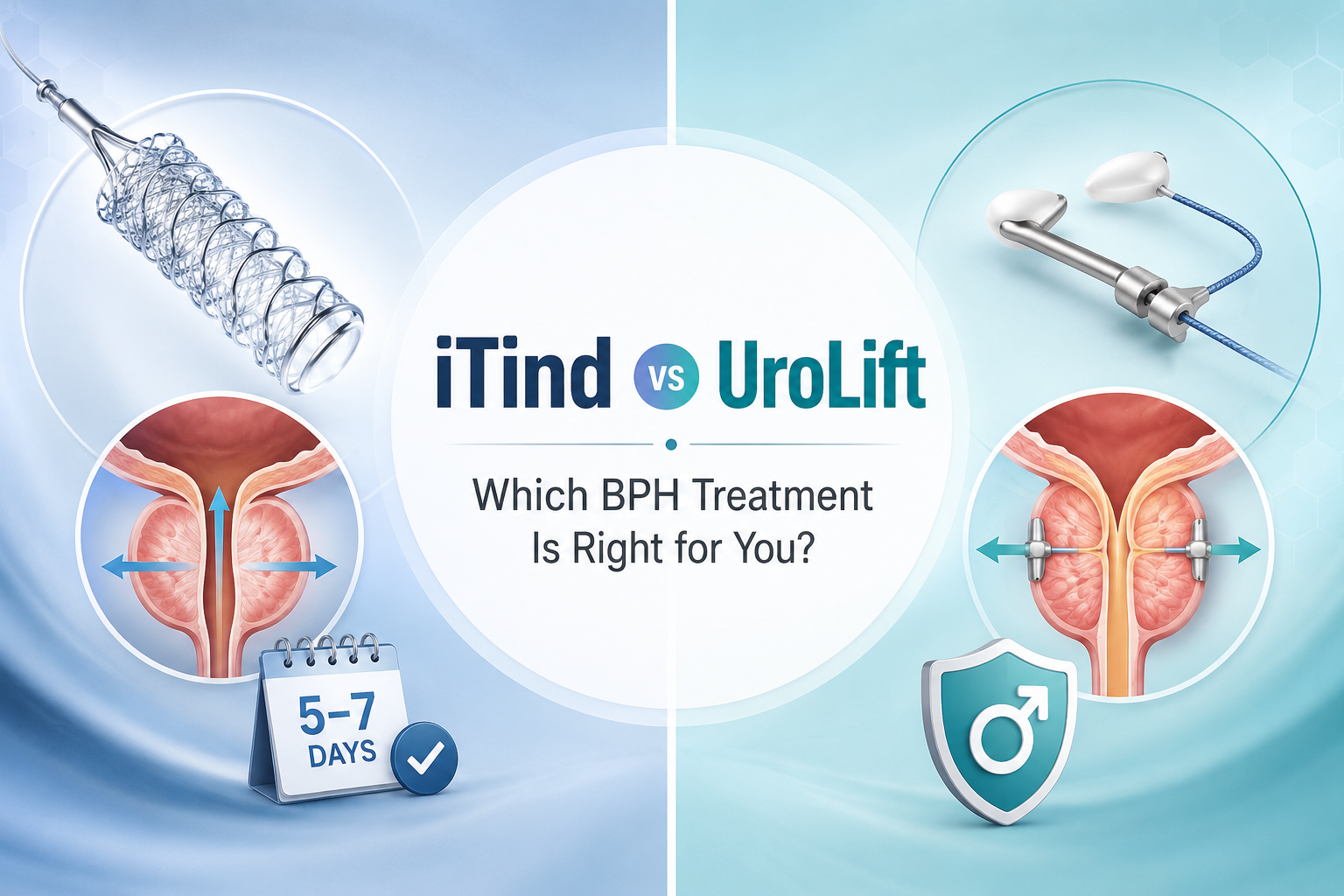
iTind and UroLift are both minimally invasive treatments for an enlarged prostate (BPH) that avoid cutting or removing tissue and protect sexual function. The key difference is that iTind is a temporary device removed after 5 to 7 days, leaving nothing behind, while UroLift places small permanent implants that stay in the prostate. iTind suits small to medium prostates and men who want nothing left inside, while UroLift suits men with enlarged side lobes who accept permanent implants. In India, iTind costs around ₹1,50,000 to ₹3,00,000, and UroLift costs around ₹2,50,000 to ₹4,50,000. The right choice depends on your prostate size, anatomy, and personal preference.
If your doctor has mentioned both iTind and UroLift, it can feel confusing. They sound similar. Both are described as minimally invasive. Both promise quick recovery and protected sexual function. Yet they work in genuinely different ways, and the right pick depends on your prostate, not on which name sounds better.
This guide compares iTind and UroLift in plain language, covering how each works, the difference between temporary and permanent implants, recovery, sexual side effects, cost in India, and who each one suits. By the end, you will be able to have a clear, confident conversation with your urologist.
iTind vs UroLift at a Glance
Here is the side-by-side comparison most men are looking for. Each row covers a factor that actually affects your decision.
| Feature | iTind | UroLift |
|---|---|---|
| Type of device | Temporary nitinol device | Small permanent implants |
| Implant left behind | No, removed after 5 to 7 days | Yes, stays permanently |
| How it works | Reshapes the prostate channel | Holds the prostate lobes apart |
| Tissue cut or removed | No | No |
| Anaesthesia | Local or light sedation | Local or light sedation |
| Catheter needed | Usually not needed | Sometimes needed briefly |
| Sexual side effects | None reported in trials | Minimal, function preserved |
| Recovery time | A few days | A few days to 2 weeks |
| Best-suited prostate | Small to medium | Enlarged side (lateral) lobes |
| Procedure time | About 15 to 20 minutes | About 30 to 60 minutes |
| Typical cost in India | ₹1,50,000 to ₹3,00,000 | ₹2,50,000 to ₹4,50,000 |
| Repeatable later | Yes | Yes |
Both are strong options. The table shows they are not rivals so much as different tools for different prostates.
What is iTind?

iTind stands for Temporary Implanted Nitinol Device. It is a small, spring-like device made from a body-safe nickel-titanium alloy. A urologist places it inside the prostatic urethra through a thin telescope, with no cutting involved.
Once inside, the device gently expands in three directions. Over the next 5 to 7 days, it reshapes the prostate opening and creates wider channels for urine to pass. After this period, the device is removed completely. Nothing stays inside the body. You can read more in our detailed guide to the iTind procedure in Delhi.
Think of iTind as a temporary support placed inside a narrowed pipe. It holds the passage open long enough for it to reshape, then it comes out.
What is UroLift?

UroLift, also called a prostatic urethral lift, works on a different principle. Instead of reshaping the prostate, it physically holds the enlarged tissue out of the way using tiny permanent implants.
A device is passed through the urethra, and small implants are placed to pull the obstructing prostate lobes aside, like tying back curtains so light can pass through. The implants stay in the body permanently and keep the urinary channel open. Most patients receive 4 to 6 implants. You can learn more on our UroLift in Delhi page.
The core idea is simple. UroLift does not remove the blockage; it lifts and pins it aside so urine flows freely.
The Key Differences Explained
The comparison table gives you the summary. These are the differences that matter most when you decide.
1. Temporary Device vs Permanent Implant
This is the single biggest difference. iTind is removed after 5 to 7 days and leaves nothing behind. UroLift places implants that remain in your prostate permanently.
For some men, leaving nothing inside is reassuring and feels cleaner. For others, a permanent implant that quietly holds the prostate open is perfectly acceptable. Neither is right nor wrong; it comes down to preference and anatomy.
2. Prostate Size and Anatomy
iTind generally works best for small to medium prostates. UroLift is especially suited to men whose enlargement is mainly in the side lobes of the prostate.
If the prostate has a large middle lobe pushing into the bladder, neither may be ideal, and your urologist may suggest a different option. This is why a proper assessment matters more than any online comparison.
3. Sexual Function
Both procedures are designed to protect sexual function, which is a major reason men choose them over TURP. In clinical trials, iTind reported no new cases of erectile dysfunction and no retrograde ejaculation. UroLift also has a strong record of preserving erectile and ejaculatory function.
If protecting sexual health is your priority, both are excellent choices, and this is rarely the deciding factor between the two.
4. Recovery and Catheter
Both offer faster recovery than traditional surgery, with most men back to routine within days. iTind usually needs no catheter. UroLift occasionally needs a short-term catheter, though many patients avoid it.
The iTind recovery includes a 5 to 7 day window while the device is in place, during which mild urgency or burning can occur. After removal, symptoms ease quickly.
5. Cost in India
In India, iTind typically costs around ₹1,50,000 to ₹3,00,000, while UroLift typically costs around ₹2,50,000 to ₹4,50,000. UroLift cost is driven mainly by the number of implants needed, so larger prostates cost more.
For a full breakdown, see our iTind cost guide and our UroLift cost guide. The most accurate figure for either always comes from a consultation.
Which One Should You Choose?
There is no single winner, because the best procedure depends on you. As a general guide:
- iTind may suit you if you have a small to medium prostate, want nothing left permanently inside, and prefer the shortest possible procedure.
- UroLift may suit you if your enlargement is mainly in the side lobes and you are comfortable with small permanent implants holding the passage open.
- Neither may be ideal if you have a very large prostate, a large middle lobe, severe obstruction, or urinary retention, in which case TURP or laser surgery often gives stronger, more durable results.
Choosing between them is like choosing between two well-made tools. Both do the job well, but one fits your hand better. A urologist confirms this by assessing your prostate size, shape, and symptoms.
How Dr. Ashish Saini Decides
The real advantage of consulting a urologist who offers both procedures is honest, unbiased advice. A clinic that only does one will naturally recommend that one. Dr. Ashish Saini performs iTind, UroLift, Rezum, TURP, and HoLEP, so the recommendation is matched to your prostate rather than to a single device on offer.
During your evaluation, he reviews your urinary symptoms, measures your urine flow, assesses prostate size and shape with imaging, and discusses your preferences around recovery and sexual function. Only then is a procedure suggested. This is the difference between being sold a treatment and being guided to the right one.
Comparing With Other BPH Treatments
iTind and UroLift are two of several minimally invasive options. It helps to see where they sit alongside the alternatives:
- Rezum uses water vapour to shrink prostate tissue and suits men with a middle lobe. See our Rezum vs UroLift comparison.
- TURP surgically removes tissue and remains the gold standard for large prostates. See our iTind vs TURP guide.
- HoLEP uses a laser to remove tissue and suits very large prostates.
The full picture is encouraging. Today, most men with BPH have several effective, less invasive choices, and surgery is no longer the only path..
Conclusion
iTind and UroLift are both proven, minimally invasive ways to treat an enlarged prostate while protecting sexual function and avoiding major surgery. The deciding factors are simple: iTind leaves nothing behind and suits small to medium prostates, while UroLift uses permanent implants and suits enlarged side lobes.
Rather than trying to pick the winner yourself, the smartest step is an assessment with a urologist who performs both. That way, the choice is built around your prostate, your anatomy, and your priorities, which is exactly how the best outcomes happen.