
}})
Here is an uncomfortable truth: most people who have a sexually transmitted infection don't know it. They have no visible rash, no pain, no discharge - nothing that clearly signals something is wrong. And because there are no obvious signs, they don't get tested, don't get treated, and unknowingly pass the infection to others.
Sexually transmitted infections (STIs) - sometimes called sexually transmitted diseases (STDs) - affect hundreds of millions of people worldwide every year. The World Health Organization estimates that more than one million STIs are acquired globally every single day. Yet stigma, embarrassment, and misinformation continue to stop people from getting the information and testing they need.
In this guide, you will learn the early warning signs of the most common STIs in both women and men, which infections tend to stay silent, and the practical do-it-yourself steps you can take right now to protect your health and the health of your partners.
Why STIs Are So Easy to Miss
The biggest challenge with STIs is not treatment - it is recognition. Most common STIs, including chlamydia, gonorrhea, and herpes, can be completely asymptomatic for months or even years. A person can feel entirely healthy, have no visible symptoms, and still be sexually transmissible.
The Silent Infection Problem
Chlamydia is the most common bacterial STI worldwide, and around 70% to 80% of women and 50% of men infected with it have no symptoms at all. Herpes simplex virus (HSV) infects an estimated 67% of the global population under age 50 - and most people who carry it have never had a noticeable outbreak. HIV can remain dormant for years before symptoms emerge.
This is why regular STI testing - not just testing when something "seems wrong" - is essential for anyone sexually active. Symptoms or no symptoms, testing is the only way to know for certain.
Common STI Symptoms in Women

Women often experience STI symptoms that are easy to mistake for other common conditions like yeast infections, bacterial vaginosis, or urinary tract infections. This overlap frequently leads to delayed diagnosis.
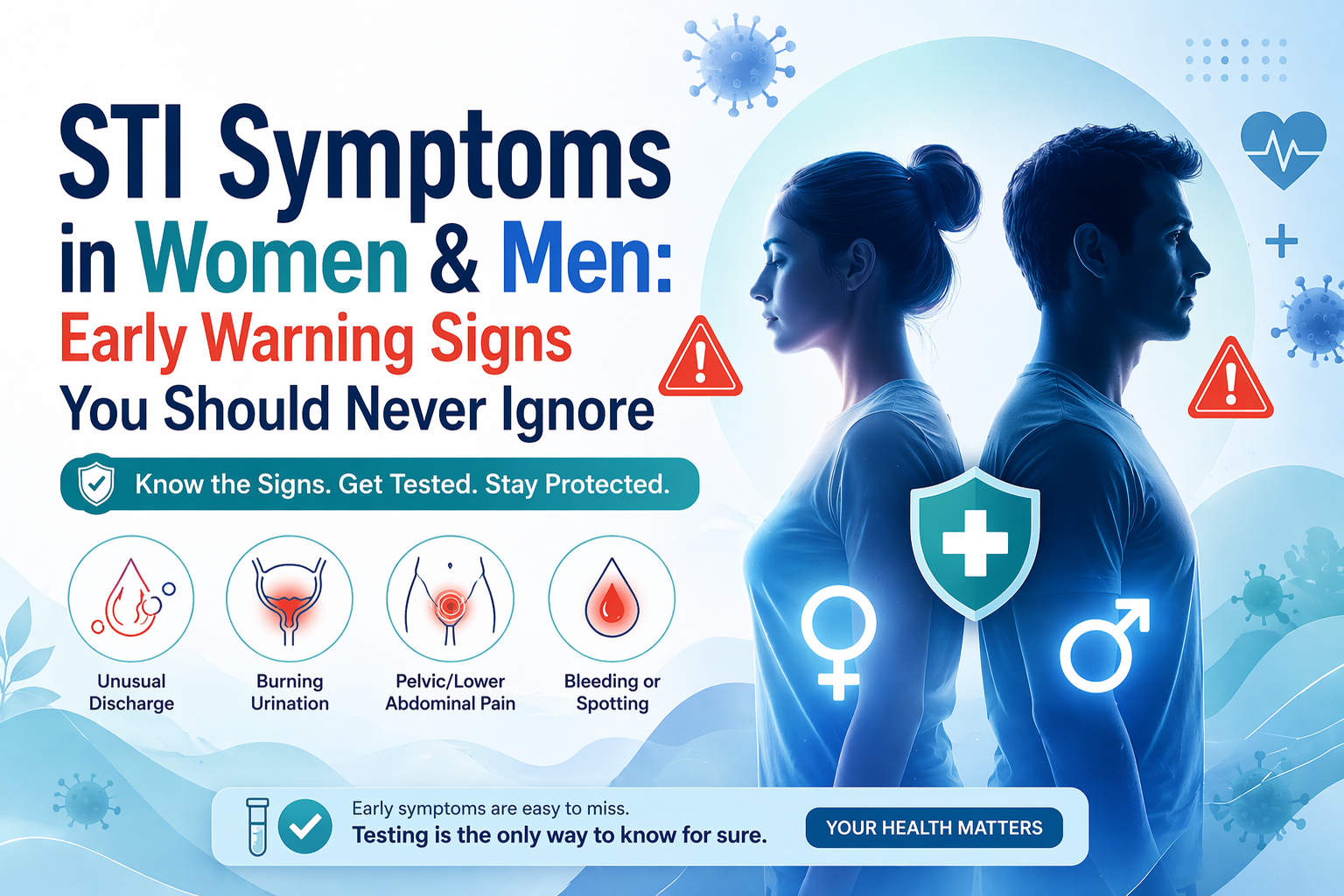
The most common STI symptoms in women include:
- Unusual vaginal discharge - changes in color (yellow, green, grey), consistency (watery, chunky, frothy), or a strong or unfamiliar smell are important warning signs. Normal discharge is clear to white and mild-smelling. Any significant change warrants attention
- Burning or pain during urination - often misidentified as a UTI, this can indicate chlamydia, gonorrhea, or a herpes outbreak near the urethra
- Pelvic pain or lower abdominal cramping - especially when not associated with a menstrual period; this can signal pelvic inflammatory disease (PID), which is often a complication of untreated chlamydia or gonorrhea
- Pain or bleeding during or after sex - irritation and inflammation of the cervix from an STI can cause spotting or discomfort during intercourse
- Irregular bleeding or spotting between periods - cervicitis (inflammation of the cervix) caused by an STI can disrupt normal menstrual patterns
- Sores, ulcers, or blisters in or around the vagina, vulva, or rectum - these can indicate herpes (HSV-1 or HSV-2) or syphilis
- Itching, redness, or irritation around the vaginal area - this can suggest trichomoniasis, pubic lice, or other STIs
Symptoms That Are Unique to Women
- Cervical changes - certain HPV strains cause changes to cervical cells that are only detectable through a Pap smear or cervical screening, with no visible external symptoms
- Pelvic inflammatory disease (PID) - a serious complication of untreated STIs affecting the uterus, fallopian tubes, and ovaries; symptoms include severe pelvic pain, fever, and, in chronic cases, infertility or ectopic pregnancy risk
Symptoms That Overlap With Other Conditions
The frustrating reality for women is that many STI symptoms closely mimic non-STI conditions:
- Vaginal discharge changes can look like a yeast infection or bacterial vaginosis
- Pelvic pain can be mistaken for menstrual cramps or IBS
- Burning urination can be confused with a standard UTI
This overlap is precisely why self-diagnosis is unreliable - and why professional testing is the only accurate path.
Common STI Symptoms in Men

Men are often less likely to notice STI symptoms because infections in men more frequently remain asymptomatic or produce only mild, easy-to-dismiss signs. This contributes significantly to the spread of STIs.
Common STI symptoms in men include:
- Discharge from the penis - any unusual fluid from the penis that is not urine or semen - particularly discharge that is yellow, green, white, or thick - is a clear warning sign of gonorrhea or chlamydia
- Burning or pain during urination - a strong burning sensation, especially at the beginning of urination, can indicate gonorrhea, chlamydia, or herpes affecting the urethra
- Pain or swelling in the testicles - epididymitis (inflammation of the tube behind the testicle) is a known complication of untreated chlamydia and gonorrhea
- Sores, ulcers, or blisters on the penis, scrotum, or around the anus - these are key warning signs of herpes or syphilis
- Itching or irritation at the tip of the penis can indicate trichomoniasis, gonorrhea, or nongonococcal urethritis
Symptoms That Are Unique to Men
- Urethritis (inflammation of the urethra) - presents as discharge and painful urination; more commonly recognized in men because the anatomy makes the discharge visible
- Prostatitis, in some cases - certain bacterial STIs can trigger inflammation of the prostate gland, causing pelvic pain and difficulty urinating
STI Symptoms Both Men and Women Share
Some STI symptoms appear the same regardless of gender:
- Sores, blisters, or ulcers in the genital area, anus, or mouth - a hallmark of herpes and syphilis at different stages
- Skin rash - syphilis in its secondary stage produces a distinctive rash that often appears on the palms of the hands and soles of the feet; it is one of the few STI symptoms that is difficult to miss
- Swollen lymph nodes in the groin - the body's immune response to an active infection, which can occur with herpes, syphilis, HIV, or gonorrhea
- Warts - flesh-colored, painless growths in the genital or anal area caused by certain strains of the human papillomavirus (HPV)
- Fever, fatigue, muscle aches, and sore throat - during the acute HIV infection stage (two to four weeks after exposure), many people experience what feels like a severe flu. This is called acute retroviral syndrome and is frequently missed or attributed to other illnesses
- Oral sores or throat infection - gonorrhea and herpes can both infect the throat, causing sore throat and visible sores in people who engage in oral sex
STI-by-STI Symptom Breakdown
Do It Yourself: Steps to Take If You Think You Have an STI
If you notice any of the symptoms described in this guide - or if you've had unprotected sex with a new or unknown partner - there are clear do-it-yourself steps you should take immediately:
1. Don't Panic, But Don't Wait: Noticing a symptom or realizing you were at risk does not mean your life is over. STIs are common, treatable, and in many cases curable. What matters now is what you do next - not how you feel in this moment.
2. Stop Sexual Activity Until You Know Your Status: The most responsible thing you can do for yourself right now is to pause sexual contact until you have been tested and - if infected - treated. This protects your partners and prevents further transmission.
3. Get Tested - Don't Self-Diagnose: Self-diagnosing an STI is unreliable and potentially dangerous. Many STIs look similar to non-STI conditions, and some have no visible signs at all. Only laboratory testing can accurately identify an STI. Options include:
- Visiting a GP or sexual health clinic
- Using at-home STI testing kits, which are widely available and test for common infections, including chlamydia, gonorrhea, syphilis, and HIV, through urine, blood, or swab samples
- Free or low-cost testing through public health services or Planned Parenthood
4. Notify Your Recent Sexual Partners: If you test positive for an STI, your recent sexual partners need to know so they can also get tested. This is one of the most important - and often most difficult - do-it-yourself responsibilities. You don't have to do this alone; many sexual health services offer anonymous partner notification support.
5. Follow All Treatment Instructions: If prescribed antibiotics, take the full course exactly as directed. If prescribed antiviral medications, use them as recommended. Do not stop treatment early because symptoms improve - incomplete treatment leads to recurrence and antibiotic resistance.
6. Retest After Treatment: For many STIs, a follow-up test confirms that the infection has fully cleared. Chlamydia and gonorrhea, in particular, should be rechecked after treatment to confirm clearance.
Do It Yourself STI Prevention Habits That Work
Preventing an STI is always better than treating one. These do-it-yourself habits are evidence-backed and significantly reduce transmission risk:
- Use condoms consistently and correctly - male (external) condoms are the most effective barrier method for reducing STI transmission. Female (internal) condoms are also effective. Use one for every sexual encounter, including oral and anal sex
- Get vaccinated - vaccines are available for HPV (protecting against strains that cause genital warts and cervical cancer) and hepatitis B. HPV vaccination is most effective before sexual activity begins, but is recommended through age 45 for many people
- Get tested regularly - if you are sexually active with more than one partner, or with a new partner whose status is unknown, regular testing (every three to six months) is the most reliable way to catch infections early
- Discuss STI status with partners - honest conversations about testing history and STI status before becoming sexually active with a new partner reduce risk for both people
- Limit the number of concurrent sexual partners - the more partners, the higher the statistical exposure risk
- Consider PrEP if at high risk for HIV - Pre-Exposure Prophylaxis is a daily medication that reduces the risk of getting HIV through sex by about 99% when taken consistently. Talk to a healthcare provider about whether PrEP is appropriate for you
- Avoid sexual activity during active outbreaks - if you or a partner has visible herpes sores, genital warts, or other active lesions, avoid sexual contact entirely until the outbreak has fully resolved
When to See a Doctor - And How to Talk to One
See a healthcare provider or visit a sexual health clinic if:
- You notice any of the symptoms described in this article
- You have had unprotected sex with a new or multiple partners
- A partner has told you they tested positive for an STI
- Your regular STI testing schedule is due
- You are pregnant - STIs during pregnancy can affect the developing baby and require specific management
If you feel embarrassed about discussing sexual health with a doctor, know this: sexual health providers hear these conversations every day, without judgment. Being honest and specific about your symptoms and sexual history allows them to order the right tests and give you the right treatment.
Conclusion & Key Takeaways
STIs are one of the most common health challenges in the world - and one of the most poorly understood because of stigma and silence. The early signs are often subtle, easily confused with other conditions, or absent. Waiting for obvious symptoms before acting is exactly what allows these infections to spread and cause long-term harm.
Here's what to take away:
- Most STIs are asymptomatic - feeling fine does not mean you are infection-free
- Women are more likely to experience internal symptoms that mimic other conditions - such as pelvic pain, discharge changes, and irregular bleeding
- Men often experience discharge, burning urination, and scrotal pain - but many infections remain silent
- Shared symptoms include sores, rashes, swollen lymph nodes, genital warts, and flu-like illness during acute HIV infection
- The do-it-yourself response to potential STI exposure includes stopping sexual activity, getting tested promptly, notifying partners, and completing treatment fully
- Prevention through consistent condom use, vaccination, regular testing, and open partner communication is your most powerful tool
- STIs are treatable - and many are curable. What matters most is early action
Your sexual health is part of your overall health. Treat it with the same seriousness, attention, and care.