
}})
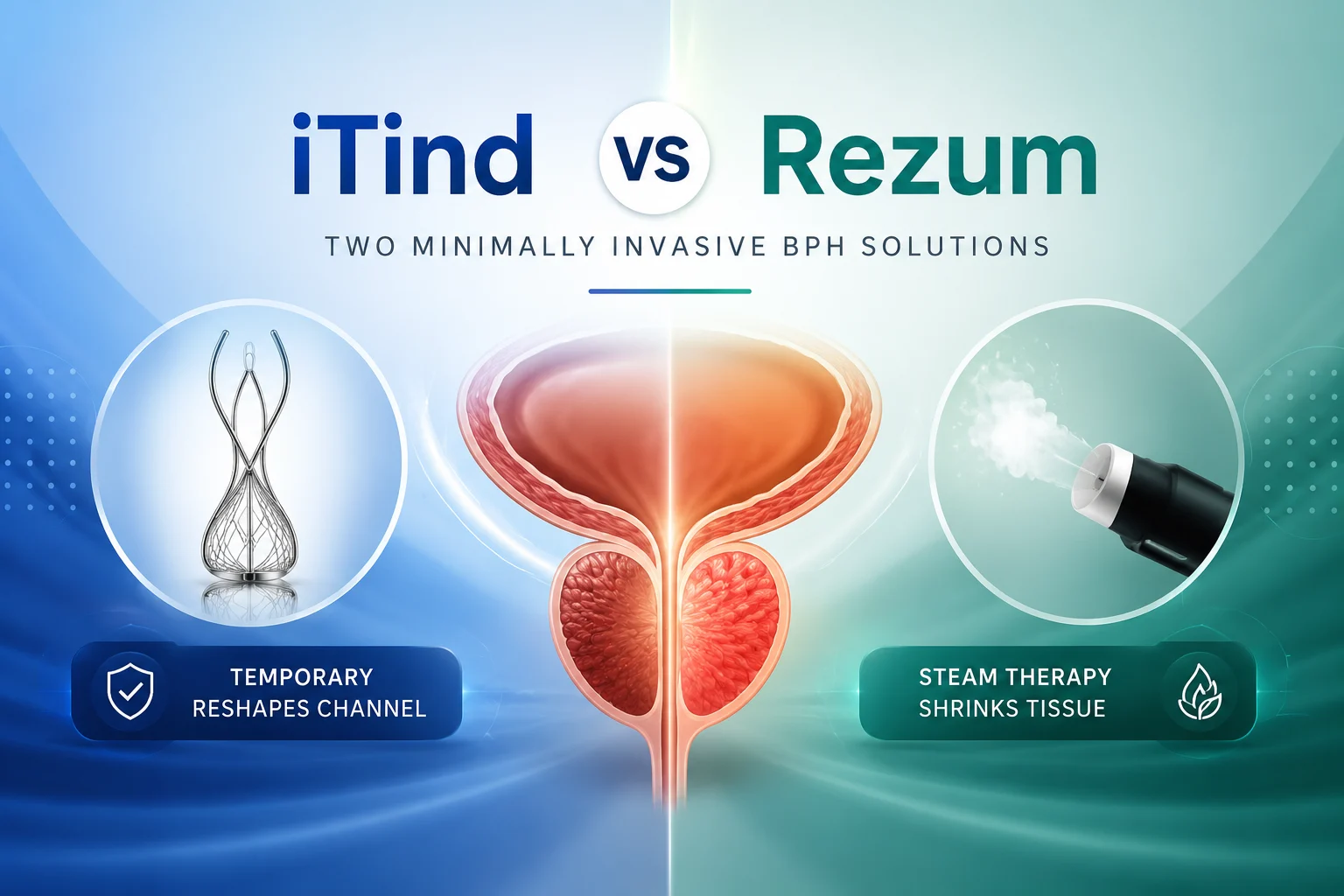
Rezum uses water vapour (steam) to shrink excess prostate tissue, treating the root cause and lasting around five to seven years. iTind places a temporary device that reshapes the urinary channel over five to seven days, then is removed, leaving nothing behind, with relief lasting roughly three years. Rezum suits men wanting longer durability from a tissue-reducing treatment, while iTind suits those who want no implant, no heat, and usually no catheter. Both preserve sexual function and avoid major surgery.
If medication for your enlarged prostate has stopped working but you are not ready for a procedure like TURP, you have probably started looking at the gentler, minimally invasive options. Two names come up constantly: iTind and Rezum. Both relieve the urinary symptoms of an enlarged prostate without cutting tissue or needing a hospital stay, yet they work in very different ways.
This guide explains exactly how they differ, who each one suits, and how to think about the choice, so you can have a focused conversation at your consultation.

Understanding an Enlarged Prostate (BPH)
An enlarged prostate, known medically as benign prostatic hyperplasia or BPH, is one of the most common conditions in ageing men. The prostate sits below the bladder and surrounds the urethra, the tube that carries urine out. As the gland grows, it presses on the urethra and slows the flow of urine, a problem doctors call bladder outlet obstruction.
This leads to the familiar lower urinary tract symptoms, or LUTS:
- A weak or interrupted urine stream
- Needing to urinate often, especially at night (nocturia)
- A sudden, urgent need to go
- Difficulty starting urination, known as hesitancy
- A feeling that the bladder never empties fully
Many men control these symptoms with tablets such as alpha-blockers for a while. When the side effects become tiresome or the medicine simply stops helping, minimally invasive treatments like iTind and Rezum offer a middle path between pills and full surgery.
What is Rezum?
Rezum is a water vapour therapy that uses the natural energy stored in steam to treat BPH. Instead of pulling tissue aside, it actively reduces the size of the prostate. You can read the full breakdown on our Rezum procedure page.
How the Rezum Procedure Works
A small device is passed through the urethra to the prostate, and short bursts of sterile steam are released into the overgrown tissue. The heat gently destroys the excess cells, and over the following weeks, the body reabsorbs them, shrinking the prostate and opening the urinary channel. The procedure is done in a clinic setting under local anaesthesia or light sedation, with no surgical incisions.

Who Rezum Suits Best
Rezum tends to be the right fit for men who:
- Want a treatment that reduces prostate volume rather than just repositioning it
- Are you looking for longer-lasting relief from a minimally invasive option
- Prefer to avoid general anaesthesia and a hospital admission
- Want to protect sexual function while still treating the underlying enlargement
The trade-off is that relief is gradual. Because the tissue shrinks over time, most men notice the benefit over two to three weeks rather than immediately, and a catheter is often needed for a short period afterwards.
What is iTind?
iTind stands for temporary implantable nitinol device. It is a clever, completely temporary approach that reshapes the prostatic urethra and then leaves the body entirely. Our iTind procedure page covers it in full.
How the iTind Procedure Works
Using a flexible cystoscope, a small self-expanding nitinol device is placed inside the prostate, often under local anaesthesia in an office setting. Over the next five to seven days, the device gently expands and applies steady pressure, reshaping the channel so urine can flow freely. After this short window, the device is removed in a quick clinic visit. Nothing is left inside the body.

Who iTind Suits Best
iTind tends to suit men who:
- Want no permanent implant and no foreign material left behind
- Prefer a treatment that uses no heat and no cutting
- Want to avoid a catheter, which most iTind patients do not need
- May want the option to repeat the treatment easily in the future
- Have not had previous prostate surgery and have a suitable prostate shape
The trade-off is durability. Because no tissue is removed, iTind is the more temporary of the two, with relief lasting around three years on average.
iTind vs Rezum: A Side-by-Side Comparison
The table below sums up the practical differences patients ask about most.
Key Differences Explained
Mechanism: Reshaping vs Shrinking
This is the heart of the decision. Rezum treats the cause by shrinking the prostate itself, so the gland is physically smaller afterwards. iTind does not remove or destroy any tissue. Instead, it remodels the urinary channel and then disappears. If the idea of permanently reducing prostate size appeals to you, Rezum fits that goal. If you would rather nothing be altered or left behind, iTind matches that preference.
Catheter and Recovery
For many men, this is a deciding practical point. iTind usually requires no catheter at all, and patients carry on with daily activities while the device does its work over five to seven days. Rezum often needs a catheter for a short stretch afterwards because of temporary swelling, though recovery is still quick, and most men return to routine within a few days.
How Quickly You Feel Better
The two procedures relieve symptoms on different timelines. With iTind, the improvement is felt soon after the device is removed at the end of the first week. With Rezum, the steam-treated tissue needs time to be reabsorbed, so the benefit builds gradually over two to three weeks. Neither is better nor worse here; it simply depends on what you expect.
Durability and Retreatment
There is an honest trade-off on how long the relief lasts. iTind typically holds for around three years before some men need a repeat or a different treatment. Rezum generally lasts longer, in the range of five to seven years, because it actually reduces the volume of obstructing tissue. iTind, however, is straightforward to repeat, which some men value as a flexible long-term plan.
Effect on Sexual Function
Both procedures are designed to protect sexual function, which is a major reason men choose minimally invasive treatment in the first place. iTind has no reported new sexual dysfunction, since it uses only gentle mechanical pressure. Rezum also preserves erectile function well and carries only a small risk of retrograde ejaculation. Compared with traditional surgery, both are far gentler on this front.
Cost in India
The price of minimally invasive BPH treatment in India varies with the device used, the hospital, the surgeon, and any sedation or follow-up costs. The iTind device and the Rezum system each carry their own pricing, so the two are best compared during a personalised consultation rather than from a generic online figure. What you are paying for in both cases is the same-day, surgery-free path to relief.
Which Procedure Is Right for You?
There is no universal winner. The better question is which one fits your prostate and your priorities. As a rough guide:
- Choose Rezum if you want a tissue-reducing treatment with longer-lasting relief and do not mind a short catheter period and a gradual onset.
- Choose iTind if you want no implant, no heat, usually no catheter, and a treatment that is easy to repeat, accepting that it lasts a shorter time.
In practice, the decision is rarely made from a checklist. It depends on your prostate size and shape on imaging, your flow readings, your general health, and what matters most to you in daily life. A careful evaluation by a specialist will make the right path clear.
How These Procedures Fit the Wider Treatment Picture
iTind and Rezum sit within a broader family of minimally invasive surgical treatments, often called MIST, alongside UroLift. Further along the spectrum are tissue-removing options such as TURP and laser procedures like HoLEP, which deliver the strongest, most durable results for larger or severely blocked prostates. If you are weighing several techniques, our iTind vs UroLift comparison is a useful next read, and you can explore the full range on our prostate disease treatment page.
Choosing well is about matching the procedure to the prostate and to your life, not chasing the newest name. That judgement is exactly what an experienced urologist brings.
Expert Care for Enlarged Prostate in Delhi NCR
When a decision is this personal, experience matters. Dr. Ashish Saini is a urologist and andrologist at Excel Advanced Urology Center in Greater Kailash 1, New Delhi, who has spent his career treating complex prostate and urinary conditions.
- MCh Urology from AIIMS, New Delhi
- MBBS and MS from KGMU, Lucknow
- 15+ years of clinical experience in urology and andrology
- 21,000+ surgeries performed across urological procedures
This depth of training means your enlarged prostate is assessed properly, with the right tests and an honest discussion about whether iTind, Rezum, or another approach truly fits you, rather than a one-size-fits-all recommendation.
If your symptoms are disturbing your sleep, your confidence, or your daily routine, you do not have to simply live with them. Book an online consultation to discuss which minimally invasive option is the best path forward for you.